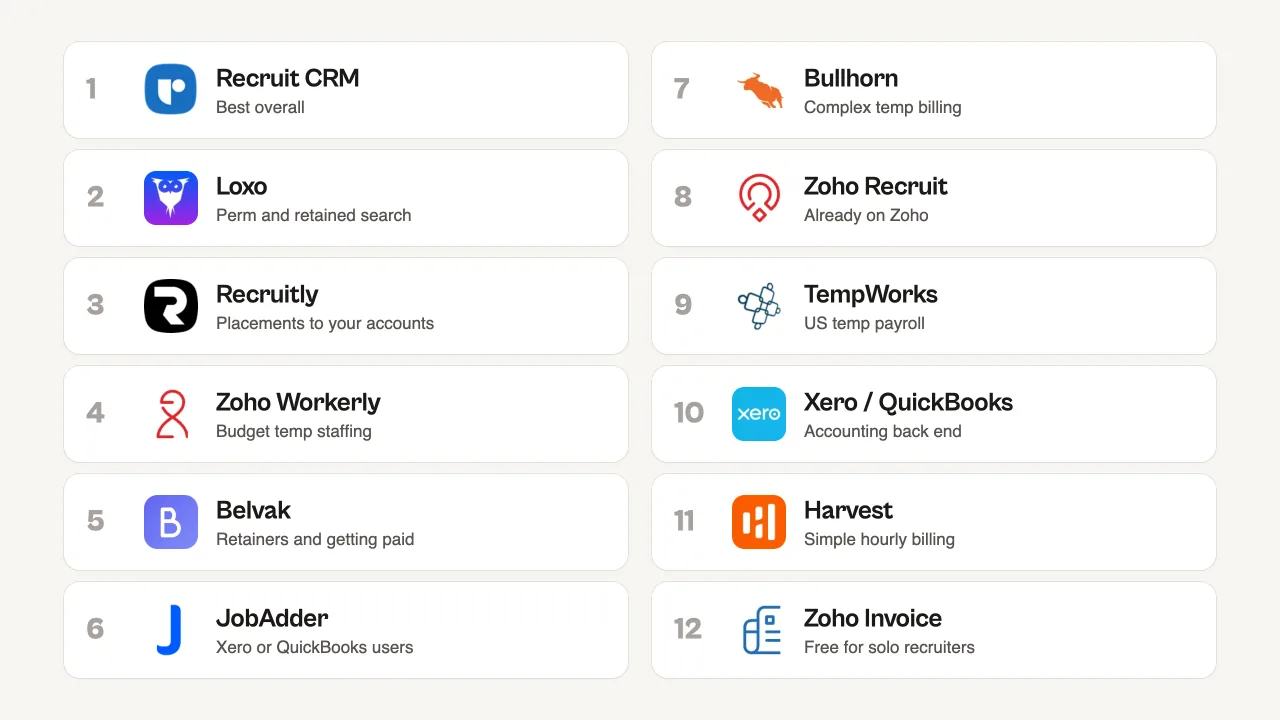
Short answer: for a small agency that bills both placement fees and contractor hours, Recruit CRM is our first shortlist choice. For permanent and retained search, look at Loxo; for temp staffing on a budget, Zoho Workerly; and for monthly retainers and getting paid, Belvak, which we make. This comparison of 12 tools is based on each vendor's own pricing and feature pages, read on 10 and 11 November 2026, not on hands-on testing.
Our picks at a glance
- Best overall for agencies doing perm and contract: Recruit CRM
- Best for permanent and retained search: Loxo
- Simplest link from placements to Xero or QuickBooks: Recruitly
- Best budget option for temp staffing: Zoho Workerly
- Best for temp firms with complex billing rules: Bullhorn
- Best for agencies billing monthly retainers and getting paid: Belvak (proposals, recurring invoices and payments in one place)
- Best free option for a solo recruiter: Zoho Invoice
Use this if you run a recruitment or staffing agency with roughly 2 to 50 people and want to stop rebuilding invoices from spreadsheets, or you are choosing your first system.
Disclosure: we make Belvak (number 5). It does not bill from timesheets, so we ranked it on the same criteria as everyone else and said plainly who should not use it. How we ranked and checked every tool is at the end.
12 invoicing and billing tools for staffing and recruitment agencies, ranked
Prices are the US list prices on each vendor's own site on 11 November 2026, before tax. Some vendors charge less in other countries, and several run first-year discounts, so check the price for your country.
1. Recruit CRM: best overall for agencies doing perm and contract

Official links:Bill and Pay(opens in a new tab)Pricing(opens in a new tab)
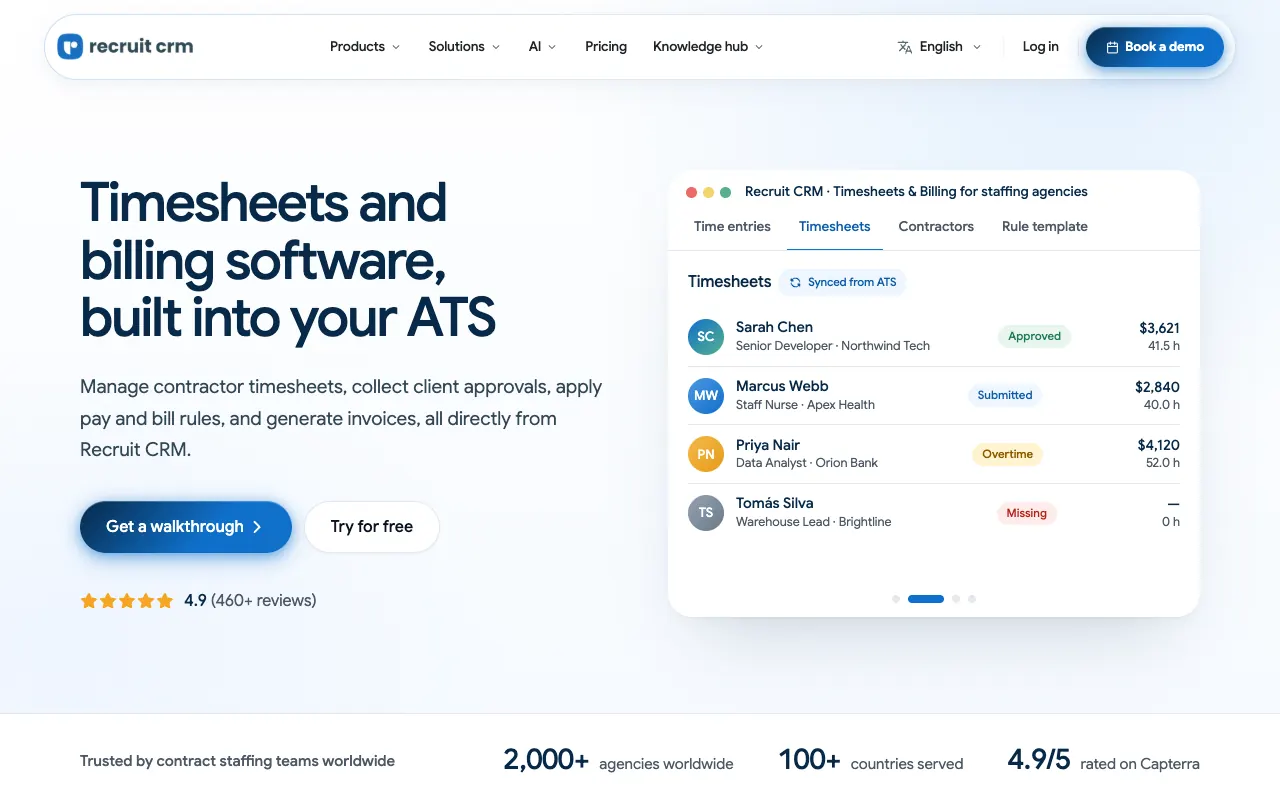
An ATS and CRM with invoicing on every plan, plus Bill and Pay for contractors: a contractor portal for hours, a client portal for approving them, bill rates set as a fixed rate, a margin or a markup, overtime and break rules, and invoices built from approved hours.
- Price: from $95 per user per month billed annually ($109 monthly) on Pro. Bill and Pay adds credits per active contractor, about $10 each for the first 15. No free plan; 30-day trial.
- Watch out for: direct QuickBooks and Xero sync for Bill and Pay was listed as coming soon when we checked, so plan on exports. It is not a payroll processor.
- Last checked: 11 November 2026, on Recruit CRM's pricing and Bill and Pay pages.
Our take: our first shortlist choice for a mixed agency, because it documents placement invoicing, client-approved timesheet billing and public pricing for both in one product. Perm-only agencies do not pay contractor credits, but should still compare it with Loxo and Recruitly. Mixed agencies should add the contractor credits to the total cost.
2. Loxo: best for permanent and retained search
 Loxo
Official links:Revenue Operations(opens in a new tab)Fee schedules announcement(opens in a new tab)Pricing(opens in a new tab)
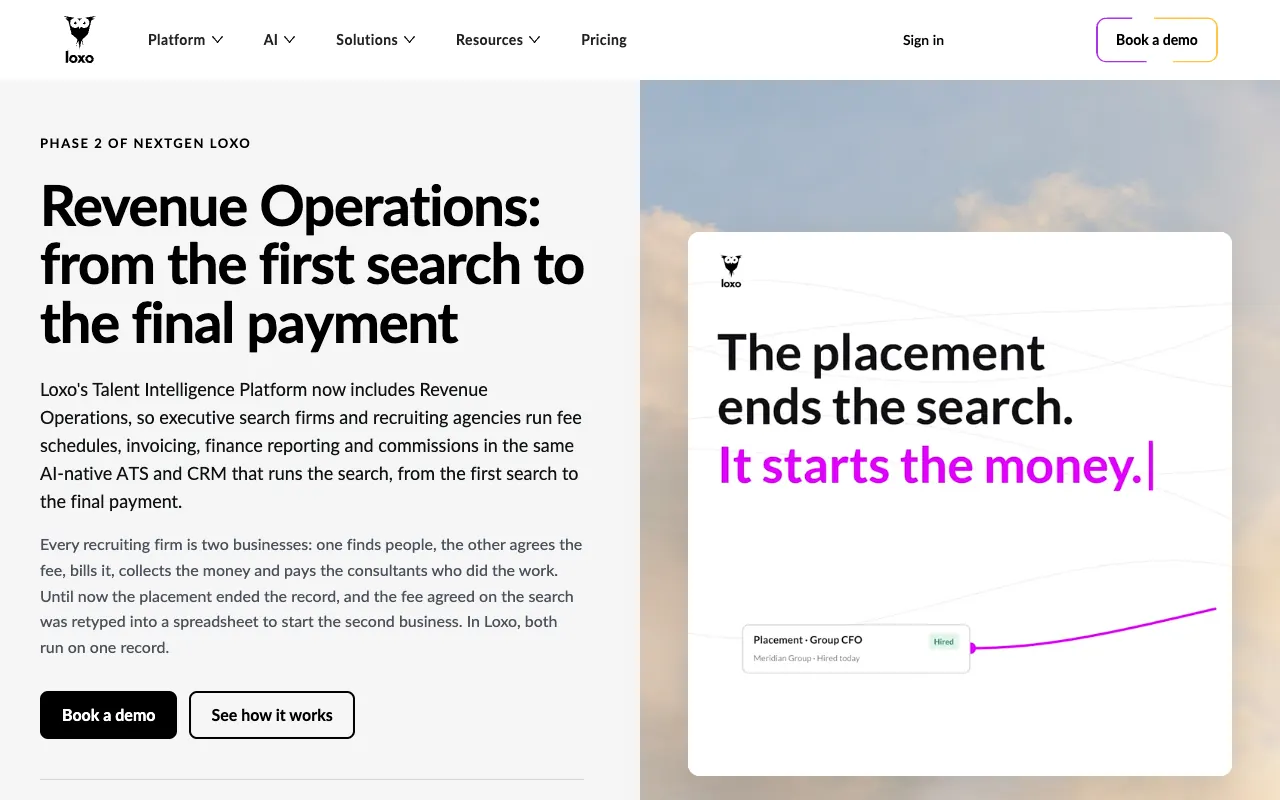
A recruiting platform whose invoices come from the placement. Since 10 November 2026 it has been rolling out retained fee schedules: each installment becomes an invoice at its milestone (job opened, shortlist, placement or a date you set), and the final invoice is adjusted to the actual first-year cash pay, less what was already billed. Contract placements carry bill and pay rates and then hand off to a separate pay-and-bill system (the hand-off to RSM InTime is live).
- Price: from $149 per user per month on Core, billed annually and paid up front (marked as a limited-time new-customer price). Professional and Enterprise are quoted. 7-day trial.
- Watch out for: the new billing features reach accounts in phases, so confirm which plan includes them and what your account has. QuickBooks and Xero are connected by your account manager. Automated invoice sending and collection start with Enterprise customers in early 2027. Timesheets and pay for contractors live in that separate pay-and-bill system, not in Loxo.
- Last checked: 11 November 2026, on Loxo's pricing and Revenue Operations pages and its 10 November announcement.
Our take: for a perm or retained firm, this is the closest match to how the work is actually billed. The final invoice trued up to the actual pay is the part most tools leave you to calculate by hand. Test a retained search with a salary change before you sign.
3. Recruitly: simplest link from placements to Xero or QuickBooks

Official links:Recruitment billing(opens in a new tab)Placement management(opens in a new tab)Pricing(opens in a new tab)
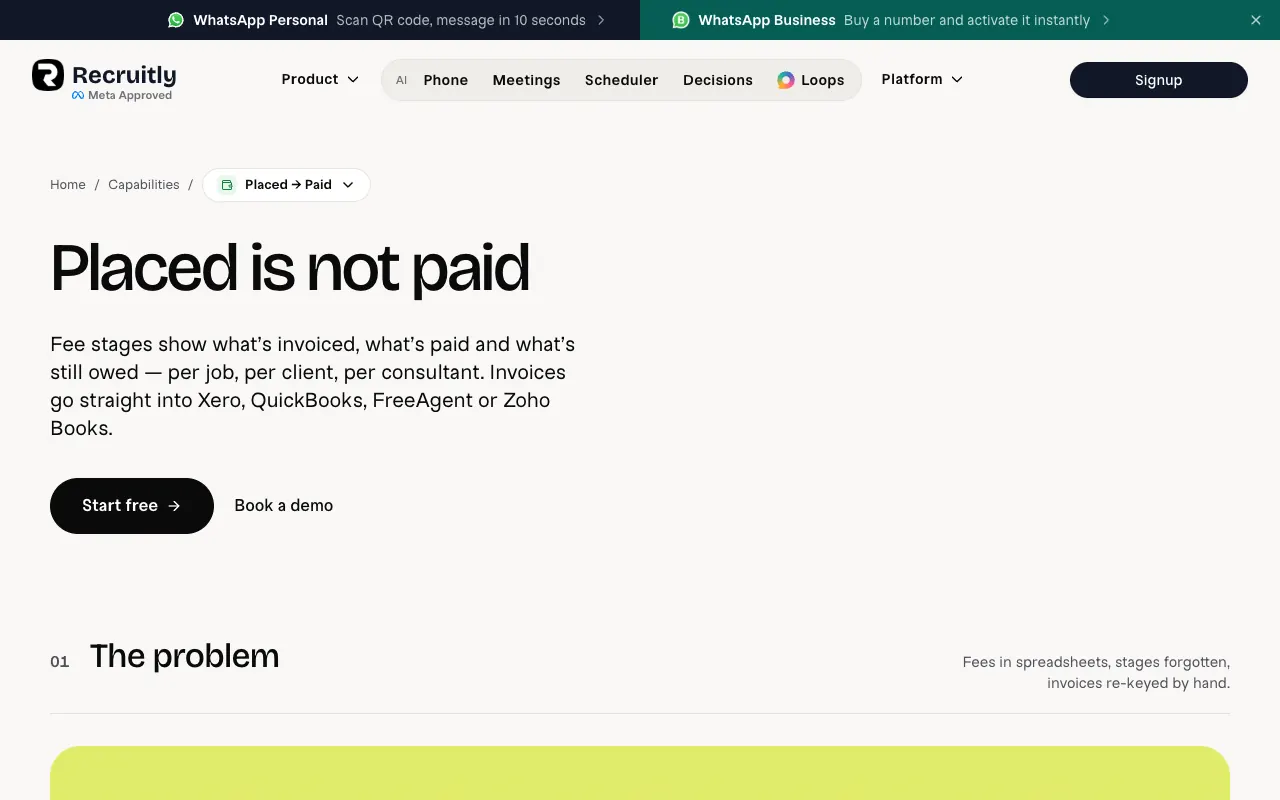
A recruitment CRM that raises a placement-fee invoice from the placement and sends it to Xero, QuickBooks, FreeAgent or Zoho Books, with the paid status coming back. It also tracks retained fee stages per job (engagement, shortlist, offer), and placements record rebate and replacement guarantee terms.
- Price: free for up to 5 users (5 jobs, 1,000 candidates). Paid plans from $25 per user per month billed annually ($30 monthly) on Solo, which is for one user; teams start at $80 per user ($100 monthly) on Professional. 14-day trial.
- Watch out for: it manages contract placements and rate changes, but its pages do not describe timesheets or client approval of hours.
- Last checked: 11 November 2026, on Recruitly's pricing, billing and placement pages.
Our take: a good fit for a perm or retained agency that wants placement fees, fee stages, guarantees and the accounting link handled in one place without a sales process. Ask it to walk through a triggered guarantee, so you see how the refund reaches your accounts.
4. Zoho Workerly: best budget option for temp staffing

Official links:Website(opens in a new tab)Plan comparison(opens in a new tab)Pricing(opens in a new tab)
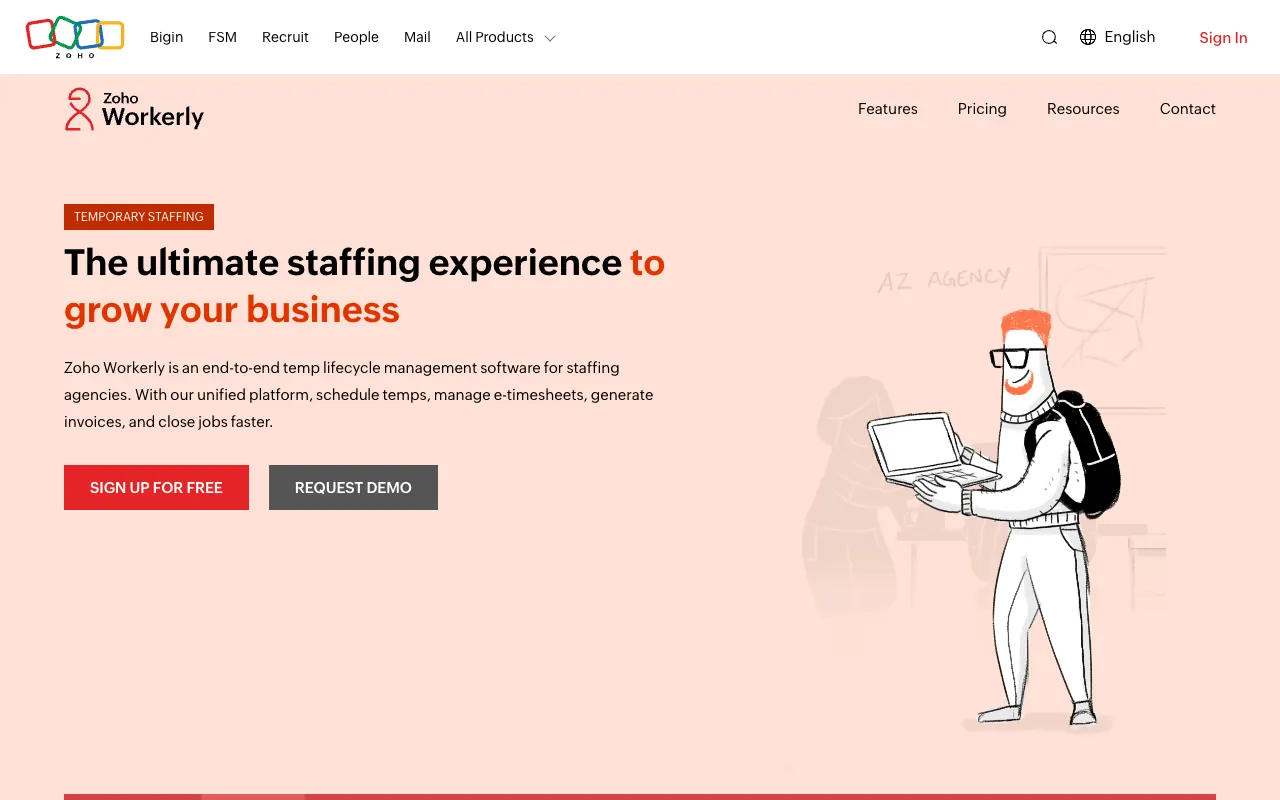
A temp staffing tool for scheduling shifts, collecting timesheets, client approval through a client portal, and invoicing from approved time.
- Price: free for 5 temps and 2 jobs, without invoicing. Premium is $52 per month billed annually ($59 monthly) for the first 25 temps, then $1.33 per extra temp ($1.50 monthly), with unlimited recruiters, one client portal licence and $3 for each extra portal licence. 14-day trial.
- Watch out for: the free plan leaves out invoicing and the Zoho Books integration, so budget for Premium. It is not a recruitment CRM.
- Last checked: 11 November 2026, on Zoho Workerly's pricing and plan comparison pages.
Our take: a budget candidate worth pricing, especially with several recruiters. It covers scheduling, approved hours and invoicing; compare payroll, compliance and accounting needs separately.
5. Belvak: best for agencies billing monthly retainers and getting paid

Official links:InvoicingStaffing agenciesPricing
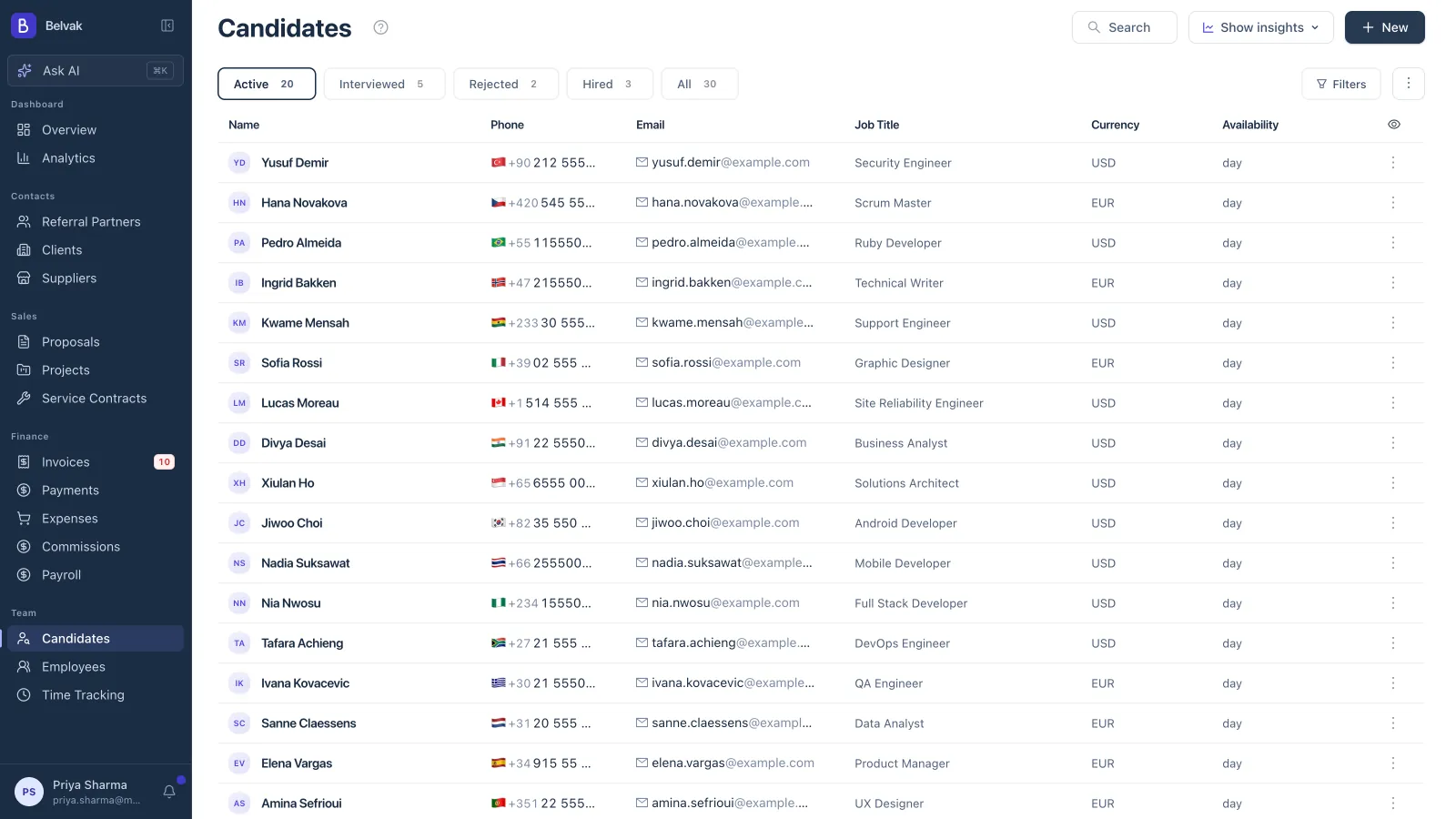
We make Belvak. It is not an ATS for client placements; it suits agencies whose admin is on the client side: proposals, retainers and getting paid.
- What stands out: an accepted proposal becomes a client project you invoice against, with partial payments, credit notes and refunds. On Professional, recurring retainer invoices are prepared for you to approve, card payments through a Stripe link are recorded against the invoice, and uploading a CV fills in the candidate's details for you.
- Price: free for one user. Professional is $15 per month including one user, then $8 per extra user ($12 and $6 billed annually), with a 14-day trial for up to five people.
- Watch out for: fees are typed in, there is no timesheet billing, and candidates do not link to client placements.
Our take: choose it when retainers and getting paid are your main admin, and a simple candidate pool is enough.
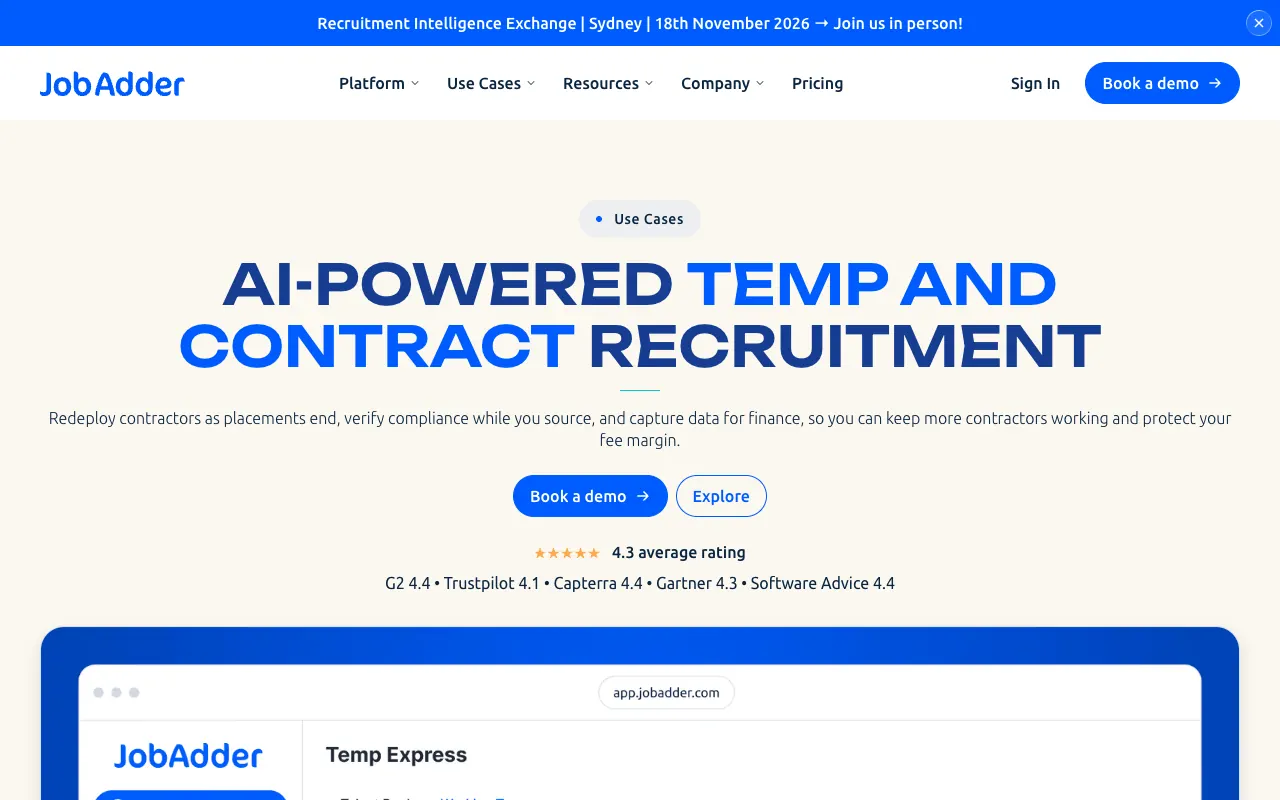
6. JobAdder: best if your accounts live in Xero or QuickBooks

Official links:Temp and contract(opens in a new tab)Xero integration(opens in a new tab)QuickBooks integration(opens in a new tab)Pricing(opens in a new tab)
A recruitment platform for perm and temp placements. Invoices raised from placements land in Xero or QuickBooks as drafts, so your accountant works where they already are.
- Price: on request only, with annual contracts as standard.
- Watch out for: timesheets come through partner integrations; confirm the partner's charges and contract terms.
- Last checked: 11 November 2026, on JobAdder's pricing and integration pages.
Our take: sensible for an agency whose accountant wants everything in Xero or QuickBooks. With no public prices, get one quote that includes the timesheet partner so you can compare like for like.
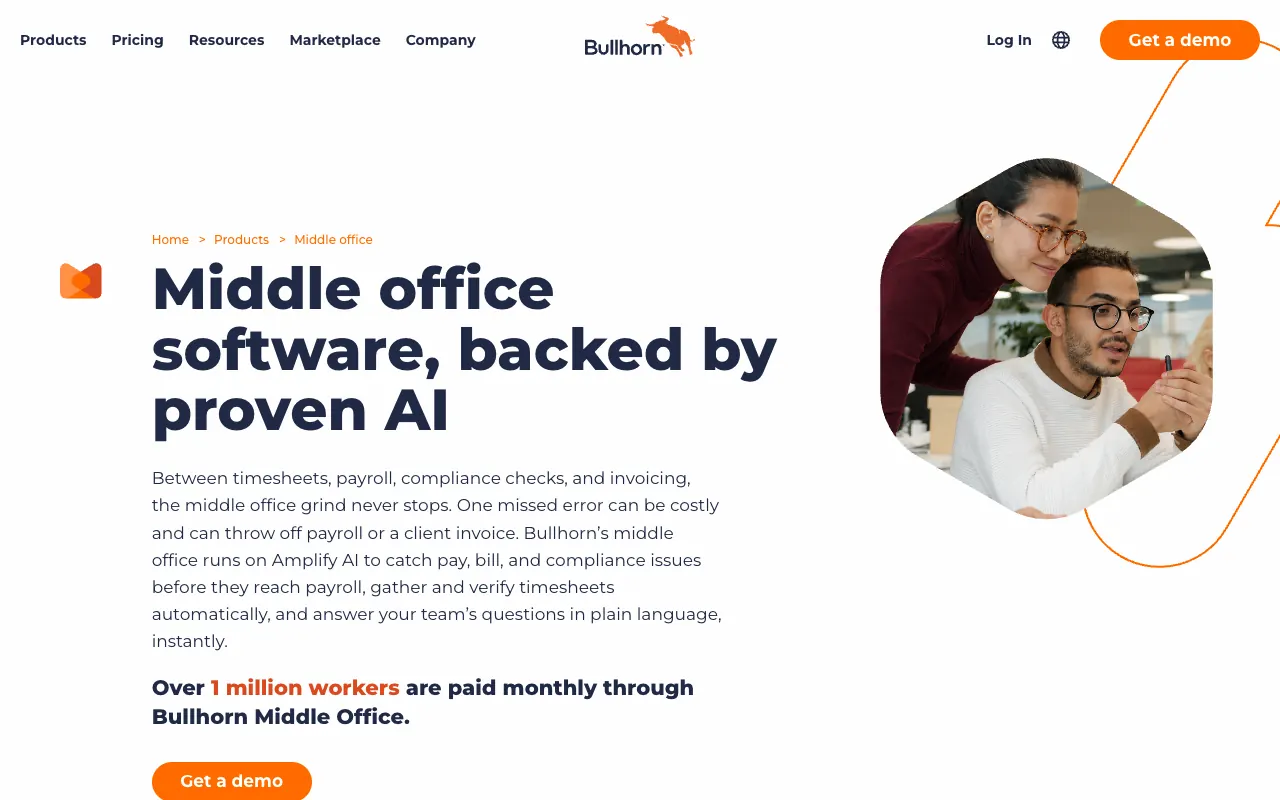
7. Bullhorn: best for temp firms with complex billing rules

Official links:Middle Office(opens in a new tab)Permanent placement invoicing(opens in a new tab)Pricing(opens in a new tab)
A long-established staffing platform. Its back office handles permanent placement invoicing, time capture, time rules and automated client-specific invoices, and Bullhorn One connects to QuickBooks Online.
- Price: from $99 per user per month (Starter) or $165 (Core) for the ATS and CRM. Timesheets and invoicing (Middle Office) are quoted. No free plan or trial.
- Watch out for: a sales process, an implementation project and a budget above the published entry price. The QuickBooks Online link needs separately purchased connector licences.
- Last checked: 11 November 2026, on Bullhorn's pricing and Middle Office pages and its help center.
Our take: we would shortlist it when complex overtime rules, many client invoice formats or high contractor volumes justify the implementation. For a small perm agency, numbers 1 to 3 are simpler to buy.
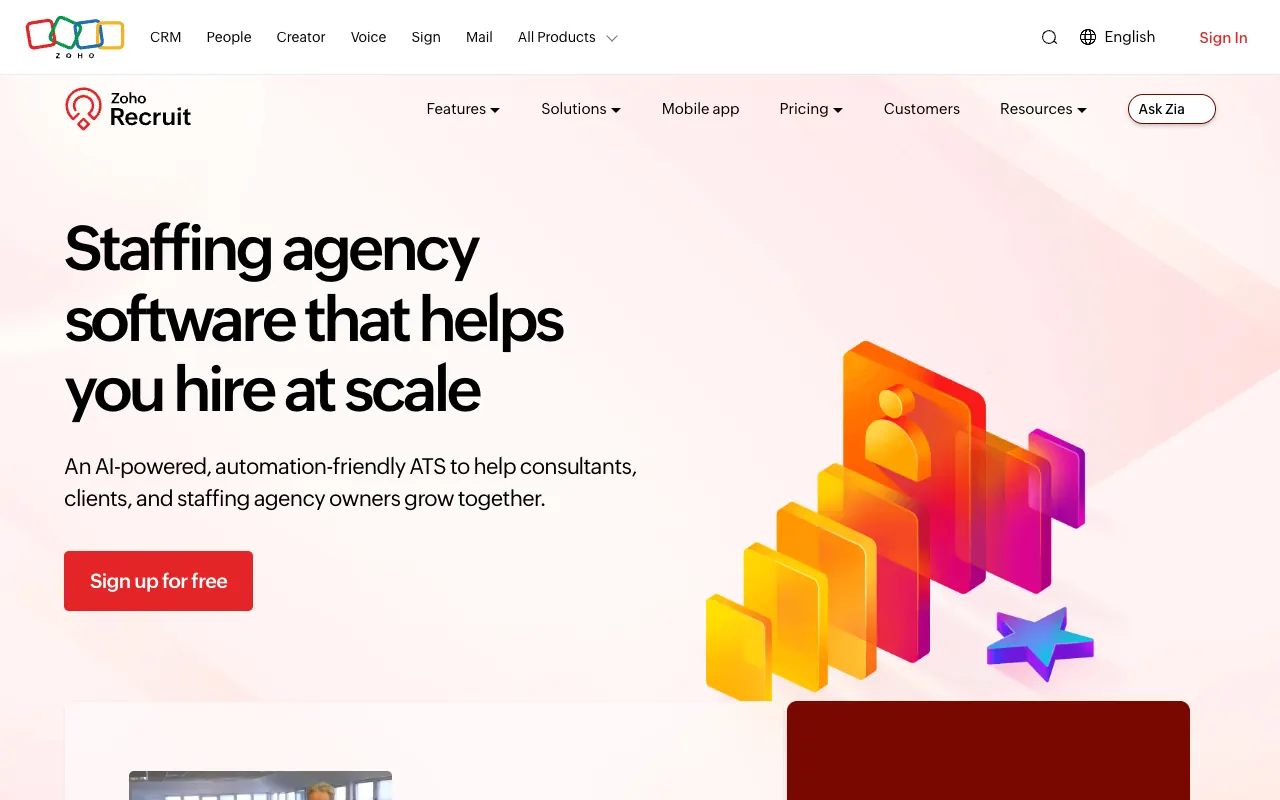
8. Zoho Recruit with Zoho Books: best if you already run on Zoho

Official links:Staffing agency edition(opens in a new tab)Zoho Books invoicing(opens in a new tab)Pricing(opens in a new tab)
The Staffing Agency edition of Zoho Recruit can create invoices from a job opening through Zoho Books or Zoho Invoice, with the client and fee per position filled in. Zoho Books can also take client approval of timesheets.
- Price: free for one active job. The staffing edition starts at $25 per recruiter per month billed annually ($30 monthly), but invoicing needs Professional at $50 ($60 monthly), plus Zoho Books from $15 per month billed annually ($20 monthly, free under $50,000 a year in revenue). 15-day trial.
- Watch out for: Recruit itself has no timesheet-to-invoice flow; that lives in Books.
- Last checked: 11 November 2026, on Zoho Recruit's pricing and staffing edition pages and Zoho's help center.
Our take: a strong choice when your accounts are already in Zoho. Otherwise, run the same invoice and refund cases through it and through Loxo or Recruitly and compare the setup.
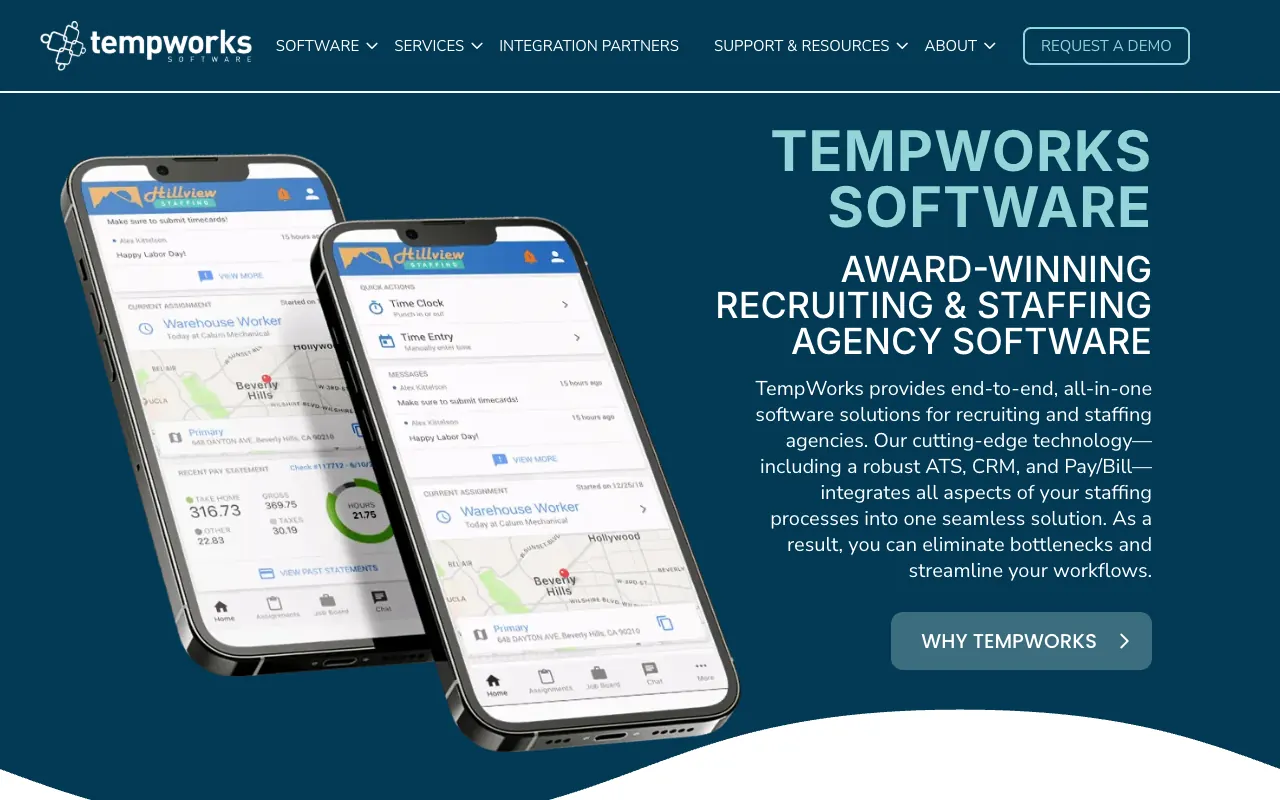
9. TempWorks: best for US agencies employing temps on their own payroll

Official links:Website(opens in a new tab)Billing manual(opens in a new tab)Avionté(opens in a new tab)
An ATS with payroll, tax, time and billing for US agencies that employ temporary workers directly, plus direct-hire invoicing on its Enterprise product and payroll funding through a partner. Avionté is another option in the same category.
- Price: quote only.
- Watch out for: built around US employment rules.
- Last checked: 11 November 2026, on TempWorks' website and billing manual.
Our take: when you carry the payroll and tax filings for your temps, a system that ties approved hours, payroll and the invoice together is worth paying for. Outside the US, or without your own temp payroll, skip it.
10. Xero or QuickBooks Online: best accounting back end

Official links:Xero invoicing(opens in a new tab)Xero pricing(opens in a new tab)QuickBooks pricing(opens in a new tab)
Many agencies keep QuickBooks or Xero behind whatever raises the invoice. Eligible QuickBooks plans include billable time, timesheets and pay, cost and billable rates; QuickBooks Time adds more advanced time tracking. Xero's Projects tracks staff costs and charge rates, included only on its top US plan.
- Price: Xero from $27 per month (Early, limited to 20 invoices) with unlimited users; QuickBooks Online from $38 per month (Simple Start, one user) or $85 (Essentials, three users), plus a free plan. Both run discounts for new customers' first months. QuickBooks has a 30-day trial.
- Watch out for: QuickBooks Online's US free plan allows one user and no accountant access, with two invoices a month unless you qualify for and turn on QuickBooks Payments, and it cannot connect to other apps, so it will not work as the accounting back end for the tools above. Neither tool is built around placements, client approval of hours or payroll for placed workers.
- Last checked: 11 November 2026, on the Xero and QuickBooks pricing pages.
Our take: you almost certainly need an accounting tool, but it should be where invoices end up, not where placements are managed.
11. Harvest: best for simple hourly billing

Official links:Website(opens in a new tab)Pricing(opens in a new tab)FreshBooks pricing(opens in a new tab)
Clean time tracking and invoices for a small contract agency billing a few clients by the hour. FreshBooks is a similar alternative, with a cap on billable clients on its cheaper plans.
- Price: free for one seat and two projects. Teams is $9 per seat per month billed annually ($11 monthly); Enterprise, which adds timesheet approval and profitability reports, is $14 ($17.50 monthly). FreshBooks starts at $23 per month for 5 billable clients, plus $11 per team member. 30-day trials.
- Watch out for: approval is internal, so clients cannot approve hours in the system, and rates live on people and projects, not placements.
- Last checked: 11 November 2026, on the Harvest and FreshBooks pricing pages.
Our take: fine when your clients are happy to approve hours by email. If they need to approve inside the system, Harvest is the wrong fit at any size.
12. Zoho Invoice: best free option for a solo recruiter

Official links:Website(opens in a new tab)Free plan limits(opens in a new tab)
A simple invoicing tool with nothing staffing-specific.
Price: free, with no paid plans: up to two users, three projects and 500 invoices a year.
Last checked: 11 November 2026, on Zoho Invoice's pricing page.
Our take: if you are one person sending a few placement invoices a month, do not pay for invoicing yet. Use this, or a free invoice generator for the odd one-off, keep good terms of business, and come back to this list when you hire.
Staffing agency invoicing software compared
How each tool bills:
| Tool | Built for | Placement fees | Client-approved hours |
|---|---|---|---|
| 1. Recruit CRM | Perm and contract | Yes | Yes (Bill and Pay) |
| 2. Loxo | Perm and retained | Yes, with fee schedules | Hands off to a pay-and-bill system |
| 3. Recruitly | Perm and retained | Yes, with fee stages | Not confirmed |
| 4. Zoho Workerly | Temp staffing | No | Yes, paid plans |
| 5. Belvak | Proposals, projects, invoices | Manual entry | No |
| 6. JobAdder | Perm and temp | Yes, as a draft invoice in Xero or QuickBooks | Through partners |
| 7. Bullhorn | Temp and contract | Yes, back office | Yes, quoted tiers |
| 8. Zoho Recruit + Books | Perm on Zoho | Yes, paid plans | Through Books |
| 9. TempWorks | US temp with payroll | Yes, direct hire | Yes |
| 10. Xero or QuickBooks | Accounting | Manual entry | No client approval |
| 11. Harvest | Hourly billing | Manual entry | No client approval |
| 12. Zoho Invoice | Simple invoicing | Manual entry | No |
How each tool connects and how you buy it:
| Tool | Accounting link | Free plan | Starting price per month |
|---|---|---|---|
| 1. Recruit CRM | Exports; API on higher plans | No (trial) | $95 per user |
| 2. Loxo | QuickBooks, Xero (set up for you) | No (trial) | $149 per user |
| 3. Recruitly | Xero, QuickBooks, FreeAgent, Zoho Books | Yes, limited | Free, then $25 per user |
| 4. Zoho Workerly | Zoho Books, paid plans | Yes, no invoicing | Free, then $52 for 25 temps |
| 5. Belvak | QuickBooks Online, one way | Yes, 1 user | Free, then $12 |
| 6. JobAdder | Xero, QuickBooks | No | Quote |
| 7. Bullhorn | QuickBooks Online (Bullhorn One) | No | $99 per user; invoicing quoted |
| 8. Zoho Recruit + Books | Zoho Books | Yes, 1 active job | Free, then $50 per recruiter plus Books |
| 9. TempWorks | General ledger export (imports into QuickBooks) | No | Quote |
| 10. Xero or QuickBooks | Is the accounts | QuickBooks, limited (US) | $27 (Xero), $38 (QuickBooks) |
| 11. Harvest | QuickBooks, Xero | Yes, 1 seat | Free, then $9 per seat |
| 12. Zoho Invoice | Zoho apps | Fully free | Free |
Starting prices are US list prices on annual billing where the vendor offers it, before tax, on 11 November 2026. "Not confirmed" means the vendor's own pages did not show it. It may exist, so ask in a demo.
Key terms
- Placement fee: a one-off fee for a permanent hire, usually a percentage of the hire's first-year salary.
- Retained search: a search paid in stages while it runs, often at engagement, at shortlist and when the offer is accepted.
- Guarantee rebate: part of the fee credited or refunded if the hire leaves within an agreed period.
- Bill rate and pay rate: what the client pays per hour for a temp, and what the temp receives.
- Markup and margin: markup is the difference between bill and pay rate divided by the pay rate; margin is the same difference divided by the bill rate.
Five cases to test before you buy
Run these through every tool on your shortlist. The numbers are examples, not industry averages.
- A placement fee: a 60,000 salary at 20% is a 12,000 invoice, before tax.
- A retained search that changes: 30% of 120,000 is three invoices of 12,000. If the final salary is 130,000, the fee becomes 39,000 and the last invoice should be 15,000.
- A guarantee refund: with a 50% rebate for a hire who leaves between weeks 4 and 12, a week-8 leaver means 6,000 back. If the invoice is unpaid, it should become a credit note; if paid, a refund against the payment with its credit note (how credit notes and refunds work). The original invoice should never be edited or deleted.
- A temp week (skip it if you only do perm): pay 30 an hour, bill 45, 40 billable hours with some overtime, approved by the client. Check the tool shows a 50% markup but a 33.3% margin before employer costs, and passes the hours to payroll.
- A month in your accounts: invoices, payments, credits and refunds should land in your accounting tool and reconcile.
Then ask for a total quote for your real users, active temps, portals, setup and integrations, not just the per-user price.
Which invoicing software fits your recruitment agency
For a 10-person agency choosing today, it comes down to where most of your invoices come from:
- Mostly hours worked: Recruit CRM if you also place permanent candidates, Zoho Workerly if you mainly fill shifts, Bullhorn or TempWorks once the billing rules or payroll need a dedicated back office.
- Mostly placement fees and retained searches: Loxo, or Recruitly if the cleanest link to Xero or QuickBooks matters most.
- Mostly retainers and getting paid, with a simple candidate pool rather than a full ATS: Belvak (see how retainer billing works).
Whatever you pick, keep your accounting tool as the place invoices end up rather than where placements are managed, and test a guarantee refund before you sign anything.
How we ranked and checked them
We ranked for one buyer: a 10-person agency choosing a new system. In order of importance, we looked at:
- Recruitment-linked billing: does the invoice come from the placement, the retained stage or the client-approved hours, or do you type it in?
- The accounting handoff: does the invoice and its payment status reach QuickBooks, Xero or Zoho Books without retyping?
- Getting paid: payment links, partial payments, credits and refunds, recurring invoices and a clear view of what each client still owes.
- Buying without surprises: published pricing, a free plan or trial, and minimums a small team can live with.
Temp specialists are ranked for agencies that bill approved hours; general invoicing tools are ranked for agencies keeping their existing ATS. Belvak is fifth because it is built around taking a client from proposal to retainer invoices you approve each period to payment tracking, but you type placement fees in yourself and it has no timesheet billing, which keeps it below the four tools that link billing to the placement or the approved hours at a published price. JobAdder, Bullhorn and TempWorks link billing too, but their invoicing is quote-only, and Zoho Recruit needs Zoho Books alongside it, so for a 10-person agency buying today we placed them lower.
This comparison is based on each vendor's own documentation, not hands-on testing of the competing products. The ranking and the "Our take" lines are our editorial judgment from those facts. Setup effort, reliability and fit still need checking in your own trial.
On 10 and 11 November 2026 we read the official pricing, feature, help and announcement pages of each tool above. Where a vendor's own pages did not confirm a feature, we marked it as not confirmed rather than rely on third-party reviews. Vendors change plans often, so check the current page before you buy.
If retainers, staged fees and getting paid are where your admin time goes, Belvak for staffing and recruitment agencies shows how proposals, client projects and invoices fit together, the invoicing feature page covers payments and statements, and the help center explains credit notes and refunds.