The short answer
An event proposal needs more than a description of the event and a price. To protect both sides it has to say what the planner earns apart from what goes to suppliers, when the client must make each decision, when guest numbers are final, who signs and pays the suppliers, what happens if the event is cancelled or moved, and when the proposal itself expires.
We checked how often the event proposal templates that rank on Google actually include those terms. Of the 11 client-facing ones we could read in full, only 1 gave the proposal an expiry date, only 1 had any rule for guest numbers, only 3 said what happens on cancellation, and only 3 said anything about who handles supplier contracts or payments.
Use this if you plan events for clients and want a proposal that wins the booking and still holds up when the guest list changes, a supplier raises a price, or the client postpones.
What we found in the top 22 results
On 8 November 2026 we searched Google (United States results) for "event proposal template", "event proposal example" and "event planning proposal template", and opened every page in the top results that offers an event proposal template or a guide to writing one: 22 pages in all, from proposal software companies, document marketplaces, event platforms and a university. We left out galleries that only show design thumbnails. For each page we checked eleven terms that decide who pays when an event changes.
Two things stood out before we even got to the terms:
- Half of them are not client proposals. By their own description, only 11 of the 22 are written for a planner pitching a paying client. The rest ask an organization or a school to approve an event, pitch sponsors, mix these purposes, or do not say. If you search "event proposal template" you can easily download the wrong kind of document.
- 9 of the 22 we could not read in full. The template sat inside an app, behind an email form, or in a file that would not open. We left those out of the counts rather than guess, which left 13 pages we could score.
Of those 13, 11 are aimed at client work: 8 client proposals and 3 that mix client and internal use (two of the 11 are writing guides rather than full templates). Here is how many of the 11 included each term:
| Term in the proposal | Included (of 11) |
|---|---|
| A payment schedule | 7 |
| What the planner does on the day | 5 |
| A process for changes or a contingency | 5 |
| A place for the client to sign | 5 |
| The planner's fee shown apart from supplier costs | 4 |
| How the planner's fee is calculated | 4 |
| What happens if the client cancels or postpones | 3 |
| Who handles supplier contracts, payments or deposits | 3 |
| Dates by which the client must decide | 3 |
| Any rule for final or changing guest numbers | 1 |
| An expiry date for the proposal | 1 |
The gaps are not small print. Guest numbers, supplier payments and cancellation are exactly where event budgets go wrong, and they are the terms most often missing. One template from a well-known proposal software company even contradicts itself: its payment schedule asks for a 15% deposit, while its cancellation clause says the client forfeits a 50% deposit.
First, check which kind of event proposal you need
The search results mix three different documents, and they are written for different readers:
- A client proposal: an event planner, agency or venue proposing to run an event for a paying client. It leads with the plan, the fee and the terms. This article and the template below are this kind.
- An internal approval request: an employee, society or association asking its own organization to approve and fund an event. It leads with objectives, budget, risks and a go or no-go date.
- A sponsorship proposal: an organizer asking companies for money in exchange for exposure. It leads with the audience and the sponsorship packages.
If you are a planner selling your services, the other two will look similar but will leave you without any of the commercial terms you need.
The six terms most templates skip, and how to write them
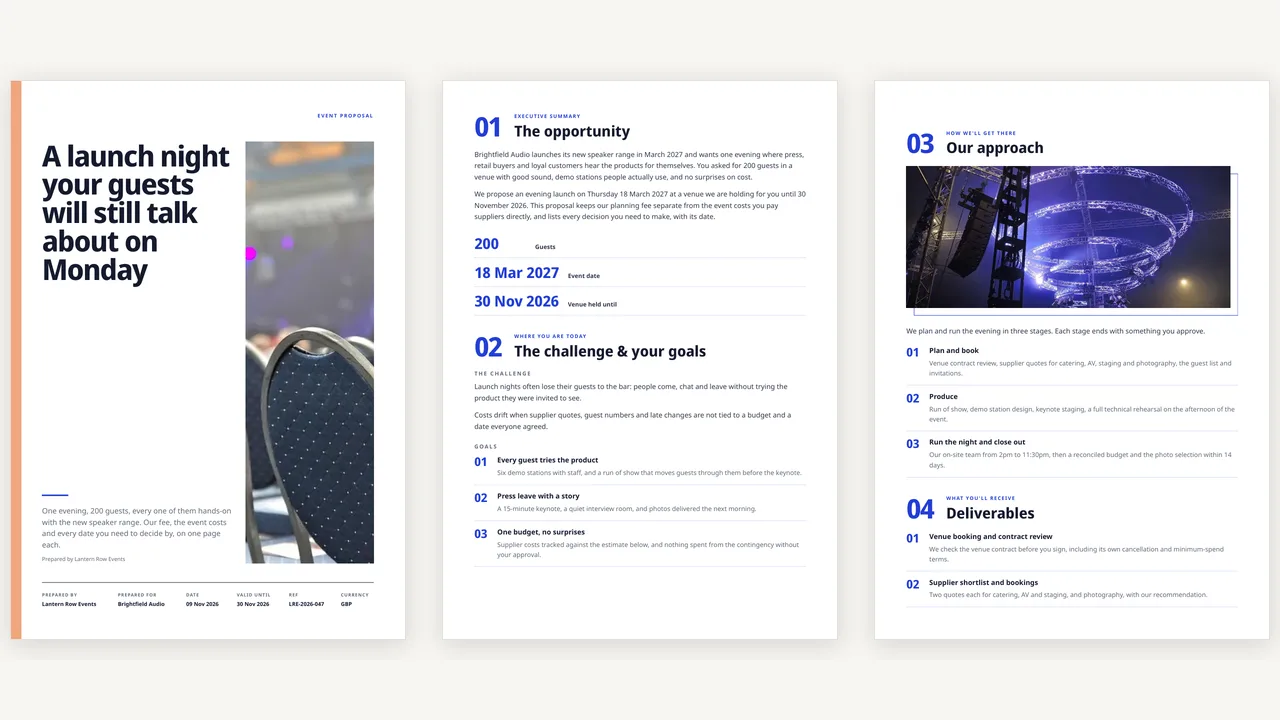
The example template is a fictional agency's proposal for a 200-guest product launch evening. Each term below is written into it, so you can copy the wording and change the numbers.
Keep your fee apart from the event costs
Show your planning fee as its own group, then the estimated supplier costs as a second group with its own subtotal. In the example the fee is £8,700 and the estimated supplier costs, including a 10% contingency, are £35,090. The client sees at a glance what you earn and what goes to the venue, caterer and AV company, and a change in catering choices visibly moves only the second number.
Put an expiry date on the proposal and tie it to the venue hold
Venues rarely hold a date forever. If your proposal is accepted after the hold has lapsed, you may be stuck with a price or a date you can no longer deliver. The example says the proposal, its prices and the venue hold all expire on the same day, and repeats that date on the cover summary, in the timeline and next to the signature.
Write the client's decisions into the timeline, with dates
Most timelines in the templates we read only list the planner's own tasks. Events slip when the client's decisions slip, so the example timeline is built from the client's side: sign and pay the deposit, approve suppliers, approve the guest list, confirm final numbers. A separate term says that if a decision arrives late, supplier prices or availability may change, and the planner reports the effect the same day.
Set a date for final guest numbers
Catering is usually charged per guest, so the proposal needs a date after which the number is fixed. The example sets it at 14 days before the event, charges catering on that confirmed number, and allows extra guests only if the venue and caterer agree. Set your own date a little earlier than your caterer's deadline so you have time to pass the number on.
Say who signs and pays each supplier
There are two common setups: the client contracts and pays suppliers directly while you manage them, or you contract suppliers and bill the client. Both work, but the proposal has to say which. The example uses the first and adds that each supplier's own cancellation and payment terms apply to their part of the event, which is the part of a cancellation the planner cannot control.
Spell out cancellation and postponement
Write the steps in days, not in general words. The example keeps the 40% deposit if the client cancels more than 90 days before the event, charges 60% of the fee between 30 and 90 days, and the full fee inside 30 days. It also allows one postponement within 12 months at no extra fee if the team is free on the new date, which gives the client a way out other than cancelling.
Work through one case before you send it. Say the client has paid the 40% deposit and the 40% second payment, so 80% of the fee, and cancels 45 days before the event. The charge at that point is 60% of the fee, so you owe the client the 20% difference: £1,740 on the example's £8,700 fee. The template says so in writing, because a cancellation clause that only lists charges leaves the refund to be argued about.
One fee, three ways to charge it
Using the example's numbers shows why the fee model belongs in the proposal. The planning work is the same in each case; only the way it is priced changes.
- Flat fee: £8,700 for the agreed scope. The client knows the number on day one, and it does not change if the catering choice does. Extra scope is quoted separately.
- Percentage of supplier costs: the same £8,700 is about 27% of the £31,900 in supplier costs before contingency. If the client then saves £5,000 on catering, the fee drops by about £1,360, although the planning work does not change. Some clients also read a percentage fee as a reason for the planner to choose more expensive suppliers.
- Hourly: the fee follows the hours actually worked, so the proposal needs an estimate of hours and a cap, or the client cannot compare it with other quotes.
None of these is wrong. But each one needs a sentence in the proposal, and a flat fee with supplier costs shown at cost is the easiest of the three for a client to read.
How we did this
We searched Google in English with United States results on 8 November 2026 and collected every template page from the first two pages of results for "event proposal template" and "event planning proposal template" and the first page for "event proposal example": 22 pages after removing duplicates, videos, Pinterest boards and design galleries. Each readable template was checked against eleven terms; a term counted when the template included it or gave a specific field for it, and pages we could not read in full were left out, not counted as missing. We checked a sample of pages by hand a second time, and where two readings differed we kept the more generous one, so if anything the gaps above are understated. Search results change, and other templates may cover more.
Using the template
- Download the Word file, replace the agency, the client, the event and the prices, then delete the blue instruction box.
- Keep the PDF as a reference for the layout and the wording of each term.
- Before sending, check the dates: the proposal expiry, the venue hold and every client decision should line up with what your venue and suppliers have actually agreed.
The example was laid out with Belvak's free AI proposal generator. For a different kind of event, it can turn a short description of the event and your own prices into a first draft, and it never invents a price. If you run events as a business, Belvak for event management companies converts an accepted proposal into a project, with the client and value filled in for you to review.