What a web design proposal should include
A web design proposal should tell the client exactly what they get, when they get it, what it costs and what you need from them. In practice that means nine parts: a short summary of their problem, the goals the new site must meet, your approach in stages, a list of deliverables with page counts, a timeline, itemized pricing, the team, terms that cover design rounds, content, exclusions, testing and ownership, and a place to sign.
Use this if you design or build websites for clients and want a proposal that wins the project and prevents the usual arguments about revisions, content and what "done" means.
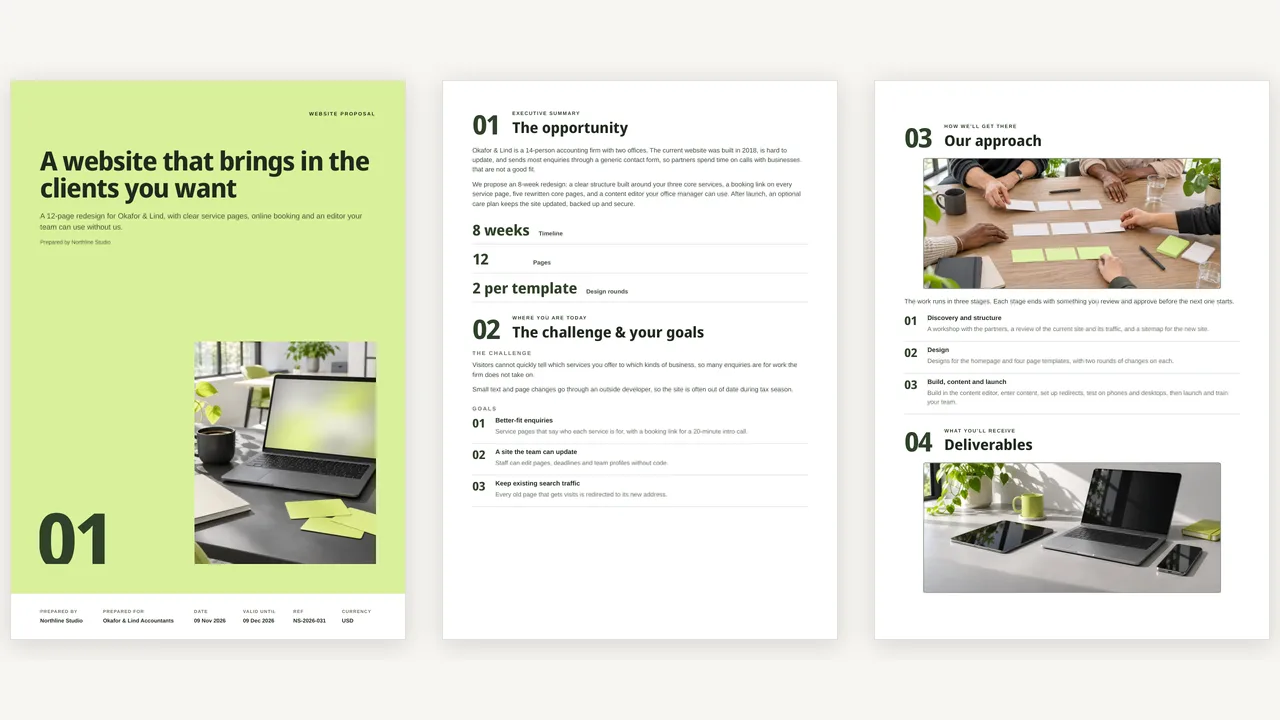
Below is a complete example, which also works as a website proposal template: a fictional studio pitching a 12-page redesign to a 14-person accounting firm. You can preview every page below, then download it as Word to edit or as PDF to keep as a reference.
A web design proposal example, section by section
The example is short on purpose: six pages, plain words, every section doing one job. Here is what each part does and why it is there.
Executive summary: the client's problem in their words
Open with the situation you heard on the discovery call, not with your studio's history. In the example, the firm's site was built in 2018, is hard to update, and sends unqualified enquiries through a generic form, so partners waste time on calls with businesses they do not serve. Then state your recommendation in one paragraph: an 8-week redesign, service pages built around three core services, a booking link on each, and an editor the office manager can use.
Three highlights sit under the summary: timeline, page count and design rounds. A client who reads nothing else still knows the shape of the project.
Goals the client can check after launch
Write goals the client can verify, not adjectives. "Modern and engaging" cannot be checked. "Service pages that say who each service is for, with a booking link" can. The example has three goals: better-fit enquiries, a site the team can update without code, and keeping existing search traffic by redirecting every old page that gets visits.
Scope: stages with an approval at the end of each
Split the work into stages that each end with something the client reviews and approves: discovery and structure, design, then build, content and launch. Approvals at each stage stop a late change to the homepage design from reopening the whole build.
Deliverables: count the pages and templates
Vague deliverables are where web projects go wrong. "A responsive website" means something different to every client. The example lists six concrete deliverables: a sitemap and page plan, the homepage and four page templates, five rewritten core pages, the booking and enquiry setup, redirects and search setup, and training with a written guide. Note the line "You write or approve the rest": it settles who writes the other seven pages before anyone asks.
Timeline: tie dates to client feedback
Show the weeks per stage, then make the dates depend on the client's part. The example's terms say feedback is due within 5 business days of each review and that late content or feedback moves the launch date by the same amount. That one sentence prevents most "why is it late?" conversations.
Pricing: separate the build from the care plan
Itemize the price in the same stages as the scope, so the client sees what each part costs: discovery, design, build, copywriting per page, redirects and search setup, testing and launch. Put hosting, updates and backups in a separate, optional monthly care plan with its own notice period. The example shows a one-time total and a separate monthly total, and never adds them together, because a client comparing quotes needs to see the real build price.
Terms that prevent the usual website disputes
Most website disagreements come from five unwritten assumptions, so the example writes them down:
- Design changes: two rounds per template, and further rounds quoted before work starts.
- Content and deadlines: who supplies what, and what late feedback does to the launch date.
- Not included: logo or brand work, photography, paid advertising and other integrations.
- Testing and fixes: a 5-day testing window before launch, and free fixes for 30 days after it for anything that does not work as agreed.
- Ownership: the site, designs and content belong to the client once the project is paid in full.
How to price a web design proposal
There is no single right price for a website, and this article will not give you a market rate. What matters in the proposal is that the price is easy to understand and hard to dispute:
- Price by stage or deliverable, not one lump sum. A client who sees "Design: homepage and four page templates" next to a number understands what changes if they cut a template.
- Use quantities where the client controls the amount. Copywriting is priced per page in the example, so adding a page has an obvious cost.
- Tie payments to milestones. The example asks for 40% to start, 40% when designs are approved and 20% at launch, so neither side carries all the risk.
- Keep recurring fees separate. Hosting and maintenance are monthly, optional and cancellable, and shown as a monthly total.
- Say whether tax is included. The example states that prices exclude tax, which avoids a surprise on the first invoice.
The example prices are illustrative. Replace them with your own rates before you send anything.
Common mistakes that stall website proposals
- Unlimited revisions. "Revisions until you are happy" turns a fixed price into an open-ended project. Name the number of rounds.
- Nobody owns the content. If the proposal does not say who writes each page, the site waits for copy that never arrives.
- No plan for old URLs. A redesign that drops pages with search traffic can lose visitors the client already had. List redirects as a deliverable.
- Hosting left vague. Clients assume the site will keep running and stay updated. Say what happens after launch, and what it costs.
- A price with no breakdown. A single number invites a single counter-offer. Line items invite a conversation about scope instead.
Web design proposal vs contract vs statement of work
A proposal is how you win the project: it explains the problem, your approach and the price, and the client signs it to go ahead. Many small studios use the signed proposal as the agreement for simple projects. Larger projects often add a separate contract for legal terms, and a statement of work that pins down the scope in more detail. Whatever you use, the scope, deliverables and terms in each document should match. If a client later asks for more, a written scope makes it much easier to handle scope creep without losing the relationship.
How to use this web design proposal template
- Download the Word file and edit it like any document: replace the client, your studio, the scope and the prices, then delete the blue instruction box.
- Keep the PDF as a reference for the layout and the wording of each section.
- Check it before you send it: every deliverable has a price and a date, the design rounds match what you can deliver, and the terms match what you agreed on the call.
The example itself was laid out with Belvak's free AI proposal generator, the same tool behind our free proposal templates. When your next project looks nothing like this one, it can turn a short description of the work and your own prices into a first draft, and it never invents a price.
When the client accepts, the work does not stop at the PDF. In Belvak an accepted proposal converts into a project in one step. On the Professional plan, the care plan can run as a service contract: each month's invoice is prepared for you to approve, so the monthly fee you promised is actually billed.