Name scope creep before it costs you the margin
Scope creep is work that changes the effort, timeline, risk, or expected outcome of a project without a matching decision about price or priority. Handling it well is not about saying no to clients. It is about making the cost of each new request visible at the moment it is made, so the client chooses knowingly instead of the change quietly landing on your team.
Use this if clients keep asking for "small" extras, your team keeps absorbing them, and your projects feel busy but less profitable than they should be.
Scope creep almost never arrives as one big demand. It arrives as a string of tiny asks, each of which feels petty to push back on, and together they eat the hours you never billed.
What counts as scope creep (and what does not)
Not every extra request is scope creep. A tweak to copy or a color adjustment is part of doing good work. Scope creep is specifically work that expands the deliverable or the effort. It usually shows up in three forms:
- Feature creep: new deliverables that were never in the proposal, like an extra page, form, or integration.
- Revision creep: more rounds of review than the project allowed for.
- Process creep: extra meetings, reports, and approvals that quietly consume delivery time.
Each type needs a different response. A new deliverable needs a change request. Extra revisions need a firmer approval process. Extra process needs a cadence reset. A clear statement of work gives you the line to point at when a request crosses it.
The early signs scope creep is happening
Scope creep is easier to stop early, so learn the signals:
- The client starts requests with "just" or "quick." When someone minimizes a request before making it, they usually already sense it is outside the agreement.
- Requests come through informal channels, like a direct message to a designer instead of the agreed process. What is not documented is not tracked, and what is not tracked is not billed.
- The original scope stops being referenced. Early on, people say "per the proposal." When creep takes hold, the language shifts to "what makes sense" or "what would be ideal," and the goalposts move without anyone naming it.
- The deadline stays fixed while the work list grows.
When the first pattern appears, address it. Waiting until the budget is gone makes the conversation feel defensive.
How to tell a client something is out of scope
This is the part everyone dreads, and the trick is to not say no. Say yes, and immediately make the cost and the trade-off visible. Adapt this neutral script:
Thanks for the added context. This request sits outside the current scope because it adds [specific work]. We can handle it two ways: we can swap it for [existing item] so the timeline holds, or add it as a change request at roughly [estimated effort or cost] with a target date of [date]. Which works better for you?
This does several things at once. It shows you are willing to do the work, so you are not being difficult. It puts a real number on a request the client may have assumed was trivial. And it forces a prioritization decision rather than a debate. Often the client simply says, "I did not realize it was that involved, let us skip it." The rest of the time they approve the change and you are paid for the work. Either outcome is fine.
A simple change request process
A conversation is good. A repeatable system is better, because it takes the decision off your team's shoulders. Keep it light enough that people actually use it:
- Any request outside the original scope gets written up in a sentence or two.
- The team makes a quick effort estimate. "Roughly eight to twelve hours" is precise enough.
- Someone sends the client a short note with the description, the estimated effort, the cost, and the timeline impact.
- The client approves or declines in writing. An email reply is enough.
- Approved changes are added to the project as their own line items, tracked separately from the original scope.
Heavy processes with formal documents and multiple sign-offs get ignored. A version that takes five minutes for you and two minutes for the client is the one that survives. Compare each request against the approved proposal so the history of what was sold, and what was added, stays clear.
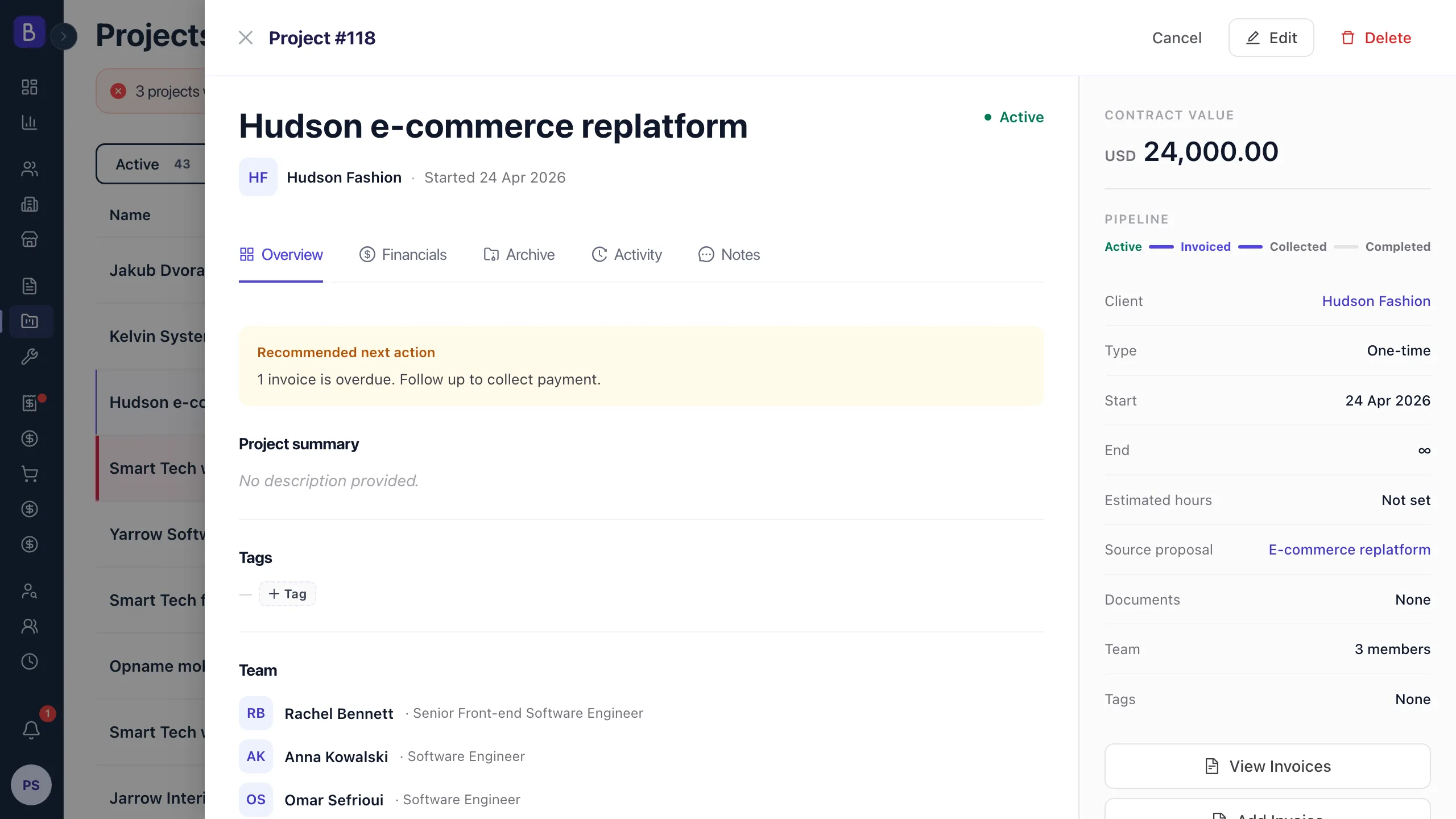
Step five is where most teams lose the thread, because the approved change ends up in an email instead of anywhere the money is tracked. The approval itself happens with the client, outside any software. Once it is agreed, record it on the one-time project as an additional work item with its title and its price. The item raises the project's effective contract value, so the overrun warning moves with the new agreement instead of firing on work the client has already approved, and one button bills that item as its own invoice when you are ready to send it.
When to absorb a request and when to bill it
You do not want to turn every tiny ask into a change order; that makes you exhausting to work with. Set a clear boundary so your team knows the rule without asking. A workable one: anything under a couple of hours that does not add a new feature, page, or integration gets absorbed. The moment a request crosses into new functionality, it becomes a change request that is documented, estimated, and approved.
For clients who change direction constantly, the pricing model itself may be the fix. A time and materials arrangement bills for the work actually done, which suits open-ended or exploratory engagements far better than a fixed price that assumes a stable scope.
What happens if you let it slide
Unmanaged scope creep does more damage than a lost hour here and there. Your best people burn out first, because they are the ones asked to build all the extra work. Your other clients get a diluted version of your attention as their hours quietly migrate to the creeping project. And the margin on what was meant to be a healthy engagement collapses, with no single moment you can point to as the cause.
The cruelest part is that saying yes to everything does not even keep the client happy. The project still runs long and feels chaotic, and they remember that more than the extras you gave away. Prevention starts before the first request: a tight client onboarding checklist that names what is out of scope on day one means the change conversation, when it comes, is one you are ready for.