What a marketing consulting proposal needs to decide
A marketing consulting proposal should settle six things before any work starts: the client's problem, what you will deliver, what the client's team must do, the schedule, the fee, and what counts as success. Everything else is supporting detail. The most common gap in consulting proposals is the line between advice and execution, so a good proposal says plainly whether you recommend campaigns, run them, or train the client's team to run them.
Use this if you sell marketing audits, strategy or ongoing advice, and you want a proposal that makes the scope, the client's responsibilities and your fee impossible to misread.
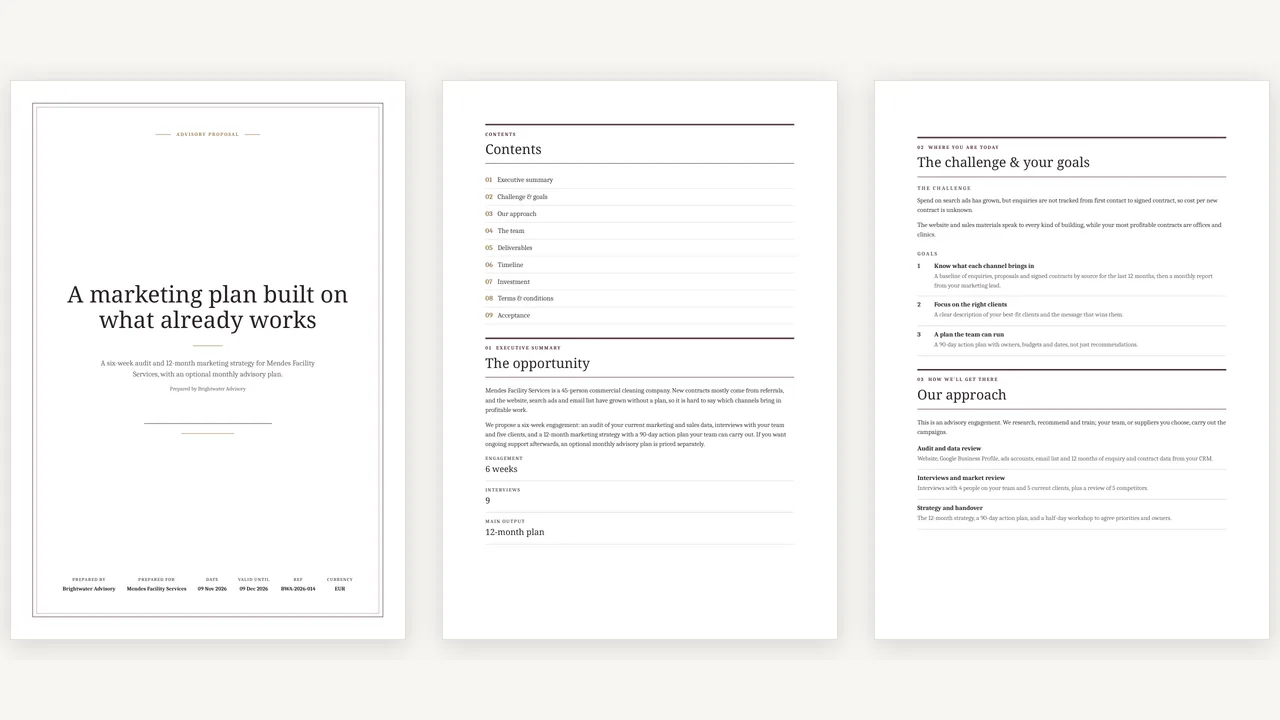
Below is a complete consulting proposal example: a fictional advisory firm proposing a six-week marketing audit and strategy to a 45-person commercial cleaning company, with optional monthly advice afterwards. Preview every page below, then download it as Word to edit or as PDF to keep as a reference.
A consulting proposal example for a marketing audit and strategy
The example runs six pages. Each section below explains what it does and the choice behind it.
The client's situation and the decisions they need to make
The executive summary opens with what the consultant heard: new contracts mostly come from referrals, while the website, search ads and email list grew without a plan, so nobody can say which channels bring in profitable work. The problem section adds two specifics: enquiries are not tracked from first contact to signed contract, and the marketing speaks to every kind of building while the most profitable contracts are offices and clinics.
That framing matters. The client is not buying "marketing consulting". They are buying an answer to "where should our marketing money go?"
The audit, strategy and handover deliverables
Each deliverable is a named document or session the client can hold you to:
- A marketing audit report: what each channel costs, what it brings in, and what to stop, fix or keep.
- A best-fit client profile and messaging guide.
- A 12-month marketing strategy with the budget split by quarter.
- A 90-day action plan with owners, dates and budgets.
- A measurement setup guide for tracking enquiries in the client's existing CRM.
- A half-day strategy workshop with the leadership team.
"Ongoing strategic support" is not on the list, because nobody can say when it is done.
What the consultant does and what the client's team does
The approach section opens with one sentence that prevents most disputes in advisory work: this is an advisory engagement, and the client's team, or suppliers they choose, carry out the campaigns. The terms then list what is not included: running campaigns, writing ads or web copy, design and managing suppliers.
The client's side is just as specific. They provide access to the website, ads accounts and CRM in week 1, a main contact who can make decisions, and interview slots with four people on their team and five clients. Delays to access or interviews move the handover date by the same amount.
The schedule, review rounds and required access
Six weeks in four stages: kickoff and data access, audit and interviews, a strategy draft with one round of written comments, then the workshop and handover. Writing down the single review round, and that further rounds are quoted first, keeps a strategy document from going through endless drafts.
Project fees and optional ongoing advice
The audit and strategy are a fixed fee, split into three line items so the client sees what each part costs. Monthly advisory is a separate, optional line: two 60-minute sessions a month plus email support, a three-month minimum, then 30 days notice. The proposal shows a one-time total and a separate monthly total, and never adds them together. Ad spend, software and supplier costs are paid by the client directly and are not in the fee. The prices are illustrative; replace them with your own.
Choose the right pricing structure
Consultants usually price in one of three ways. Pick one per engagement and say why it fits.
A fixed fee for an audit or strategy project
Best when the work has a clear end and clear outputs, like the audit and strategy in the example. The client knows the cost up front, and you carry the risk of the work taking longer, which is why the deliverables and review rounds must be specific.
Hourly advice with an agreed limit
Useful for open-ended questions where the amount of work is hard to predict. Agree a rate and a spending cap, and say what happens when the cap is reached: you stop and ask before going further.
A monthly retainer with defined access
Suits ongoing advice after a strategy is in place. Define what the client gets each month, such as a number of sessions and how fast you reply by email, rather than "unlimited access". Our glossary entry on retainer billing covers how retainers are usually invoiced.
Define success without promising results
Marketing proposals often slip into promising outcomes the consultant does not control, like a sales target or a cost per lead. The example separates two things:
- Deliverable acceptance: the client approves the audit, the strategy and the plan. This is what the fee pays for.
- Business performance: enquiries, proposals and signed contracts by source, measured against a 12-month baseline. These are goals to measure against, and the terms say plainly that they are not guaranteed results.
To make measurement real, the proposal names the baseline period, the metrics, where the data comes from (the client's CRM), and who reports on it (the client's marketing lead, monthly). Without those four, nobody can say later whether the strategy worked.
Review the proposal before you send it
Run through this checklist before the proposal leaves your inbox:
- Every deliverable has a format, a date and a price.
- The line between advice and execution is written down.
- The client's responsibilities have deadlines, and late inputs move your dates.
- Optional work is marked optional and kept out of the one-time total.
- No sentence promises a result you do not control.
- Testimonials, case studies and credentials are real, or removed.
Speed matters too. A clear proposal sent within a few days of the discovery call usually does better than a polished one sent a week later; our guide to winning more proposals covers timing and follow-up.
How to use this marketing consulting proposal template
- Download the Word file and edit it as a normal document: replace the client, your firm, the scope and the fees, then delete the blue instruction box.
- Keep the PDF as a reference for structure and wording.
- Run the checklist above before it goes to the client.
The proposal was laid out with Belvak's free AI proposal generator. For an engagement that looks nothing like this audit, the Consulting and Marketing designs in our free proposal templates start from a short description of the work and your own fees, and the generator never invents a price.
When the client signs, Belvak for consulting firms converts the accepted proposal into a project. On the Professional plan you can also track time against the fixed fee and run the advisory retainer as a recurring project, with each month's invoice prepared for you to approve, so what you promised and what you bill stay the same.