You win more proposals before the document, not by discounting
You win more proposals mostly by fixing what happens around the document, not by cutting your price. The biggest levers are responding fast while the client is still in buying mode, qualifying hard so you only propose on work you can win, building the proposal around the client's problem instead of your company, presenting price as the value it buys, and following up like a person. When firms interview the prospects who said no, price is rarely the reason. It is almost always speed, fit, or a proposal that felt generic.
Use this if you write detailed proposals but keep losing to silence, slow responses, or the sense that the work went to someone who "understood the business better."
Respond faster than your competitors
Speed is the most underrated lever in proposals. When a prospect is actively looking for a provider, they are motivated and comparing options, and that urgency fades a little every day. A proposal that lands within a couple of days of the discovery call routinely beats a more polished one that arrives a week later, because by then the client has already read two others and started leaning.
Make a rule and hold it: every proposal goes out within about 72 hours of the discovery call. If you cannot write the full version that fast, send a one-page recap with the problem, your likely approach, and a price range, and promise the detailed version to follow. That recap alone wins deals, because the client feels momentum. Reusable structure and templates are what make this speed possible, and a free AI proposal generator can produce a solid first draft in minutes with no signup, which you then tailor rather than starting from a blank page.
Qualify before you write (the deals you should skip)
A low win rate is often a proposing-to-the-wrong-people problem. Every hour spent on a proposal that was never going to close is an hour stolen from one that could. Before you invest real time, look for real signals of a winnable deal. Aim for a clear yes on most of these:
- Is there a real budget? Not "what can you do for a small number," but a genuine allocation. A refusal to discuss any range often means price shopping or no authority to spend.
- Is there urgency? Ask why now, and what happens if they do nothing. If the honest answer is "nothing much," the project will likely stall even if you win it.
- Are you talking to the decision maker? If your contact has to run it up the chain, your proposal gets judged by someone who never met you and compares on price alone.
- Is this work you are genuinely good at? Proposing on anything adjacent to your skills leads to weak delivery and mediocre references. Propose where you are confident you will excel.
- Can you actually start in their timeframe? Be honest about availability up front rather than winning and then scrambling.
Qualify harder and you send fewer proposals, win a higher share, and free your team for billable work. The good-fit projects you do win deliver better, which produces better references and more inbound. It compounds.
Structure a proposal that gets read
Long proposals do not get read. A tight one built around the client wins more often than an eighteen-page company brochure. A structure that works:
- Their problem, in their words. Open by restating what they told you in discovery. It proves you listened and frames everything around their need, not your capabilities.
- Your approach. How you would solve it, in plain language and clear order. No methodology buzzwords.
- What they get. Concrete deliverables, named specifically. Clients want to know exactly what they are paying for.
- Timeline, team, and investment. Milestones, the actual people who will do the work, and the price.
- Why you, briefly. Two or three relevant examples with specific outcomes, placed last, not first.
Whatever you deliver, keep it consistent across proposals so nothing gets forgotten and so an approved proposal converts cleanly into the work. When the client accepts, that scope and those deliverables become the statement of work that keeps delivery honest, so write them as if they will be enforced, because they will.
Present price as value, not a line item
Where and how you present price changes how it lands. Put it after the scope and deliverables, not at the top, so the number is read in the context of what it buys. Framing it as an investment tied to a result, rather than a count of hours, connects the figure to the outcome the client actually wants.
Resist the reflex to discount when a prospect goes quiet. Silence is usually about speed, fit, or unclear value, not price, and cutting your number to chase a bad-fit deal trains the client to expect discounts and erodes the margin you need. If budget is genuinely the blocker, offer a smaller, well-defined first phase instead of a cheaper version of the whole thing.
Follow up like a person, not an autoresponder
Most firms either follow up once and go quiet or set an automated sequence of increasingly needy check-ins. Both underperform. A short, personal note a few days after sending works far better than a generic status chase. Send something useful: a relevant article, a thought about their project, an answer to a question they raised on the call. It shows you are still thinking about their problem and gives them an easy reason to reply.
Timing the nudge helps, and this is where visibility matters. In Belvak, proposal share links track engagement, so you can see the view count, time on page, and when the proposal was last opened. A prospect who reopened the document twice yesterday is worth a call today; one who never opened it needs a different message entirely. If you hear nothing after a week, send one more short, direct note, then stop. Interested buyers respond; endless follow-up only annoys the ones who will not.
Learn from your rejected proposals
Your win rate is a lagging indicator; by the time you are writing the proposal, most of the outcome is already set. To improve it, study the ones that did not land. Keep a simple record of proposal outcomes, and when a proposal comes back rejected, sort the reason into a category: went with an existing relationship, felt too generic, response was too slow, wrong fit, no decision, or unclear problem.
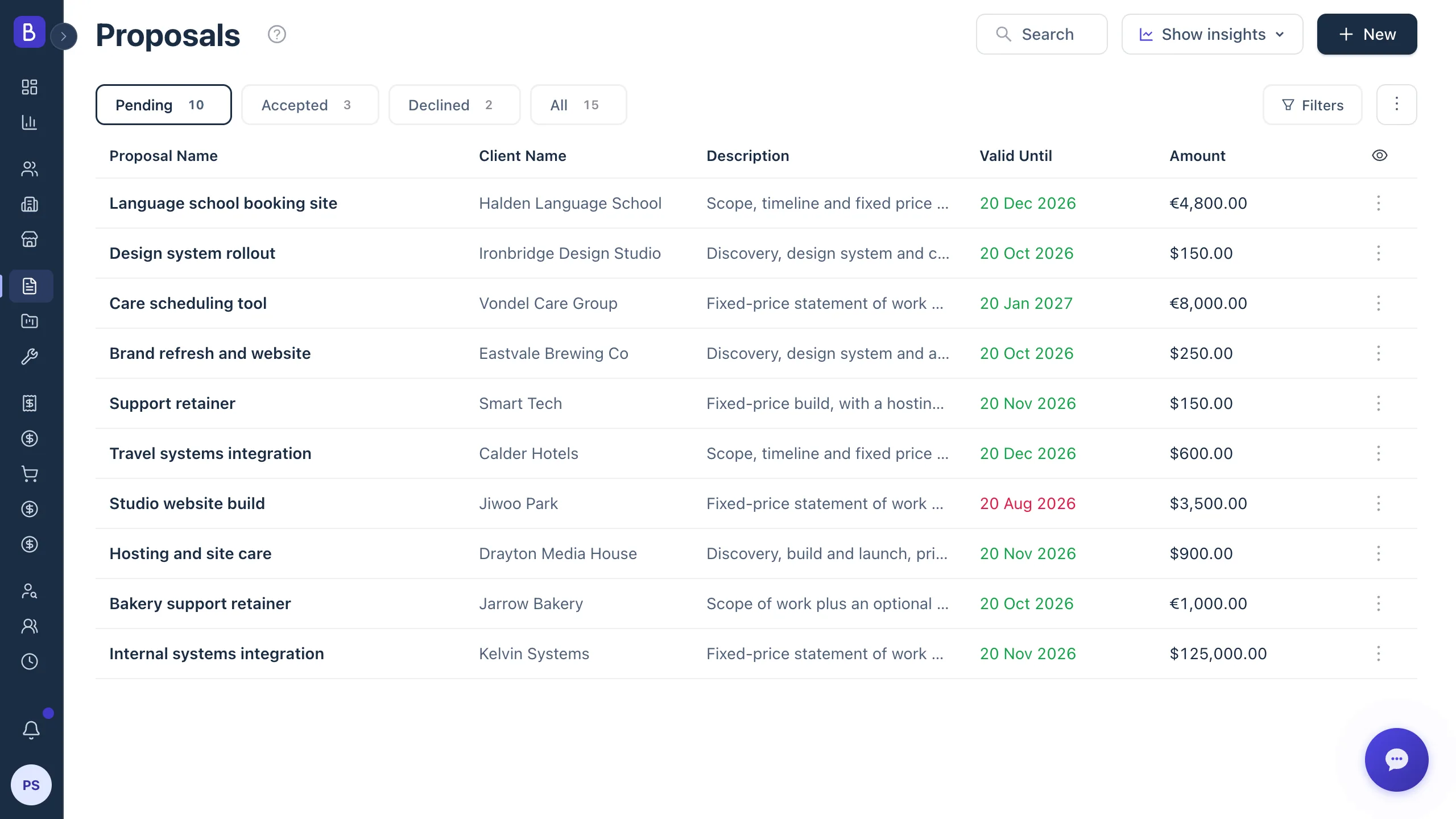
Tracking proposal status from Pending to Approved or Rejected in one place, rather than in scattered emails, makes the pattern visible. If most losses are "no decision," your qualification is too loose. If they cluster on "too generic," your proposals are not tailored enough. If speed keeps coming up, fix your response time first. Managing this in proposals also means an approved one carries its details straight into the project, and the proposal-to-invoice pipeline explains how that clean handoff keeps a won deal from leaking value on its way to getting paid.
Winning more proposals is rarely about the document itself. It comes from responding faster, qualifying harder, tailoring every proposal to the client in front of you, and following up like a human. Do that, and you send fewer proposals, to better prospects, and win a much larger share of them, without ever touching your price.