Managing maintenance contracts means keeping four things visible
A maintenance contract is a recurring service agreement where a client pays a set fee per period, monthly or yearly, for ongoing work such as monitoring, updates, support, or scheduled visits. Managing one well means keeping four things visible at all times: what is covered, when it renews, whether each period has been billed and paid, and whether the contract is still profitable.
Use this if recurring service work currently lives in spreadsheets, calendar reminders, or one person's memory, and renewals or payments occasionally slip.
What is a maintenance contract?
A maintenance contract turns one-off support into predictable, recurring revenue. Instead of quoting each small job, you agree a scope and a per-period price, and the work repeats on a schedule. A maintenance contract is defined by three things: what is included, how often it bills, and when it ends, or whether it runs open-ended until either side cancels. Get those three clear and most disputes never happen.
Recurring service is worth getting right because a client on a maintenance contract is usually worth more over time than a one-time project client, and steady contract revenue is your buffer against the feast-or-famine cycle of project work.
Define what is covered before the first invoice
Most maintenance problems trace back to a vague scope. "Ongoing website maintenance" means nothing six months later when a client expects a slow-site fix "under maintenance" and you think it is extra. Write the service level in operational terms:
- Response time for requests.
- Included visits or hours per period.
- What is explicitly not included.
- The emergency process.
- Reporting cadence.
- Renewal notice period.
This feels like overkill while you are closing the deal. It is the cheapest insurance you will ever buy.
Price per period, not per contract
A maintenance contract is billed per period, so the number that matters is the price for one billing cycle, not a lump contract total. Decide whether the contract bills monthly or yearly, set the per-period amount, and let it repeat. Recurring service should carry a better margin than project work because it is predictable and lower risk. If you are pricing maintenance at your project hourly rate, you are usually leaving margin on the table.
Managed service providers and facilities teams live on this model. If you run one, see how Belvak works for managed service providers or facilities management, where contracts, coverage periods, and billing sit together.
Track renewal windows so nothing lapses
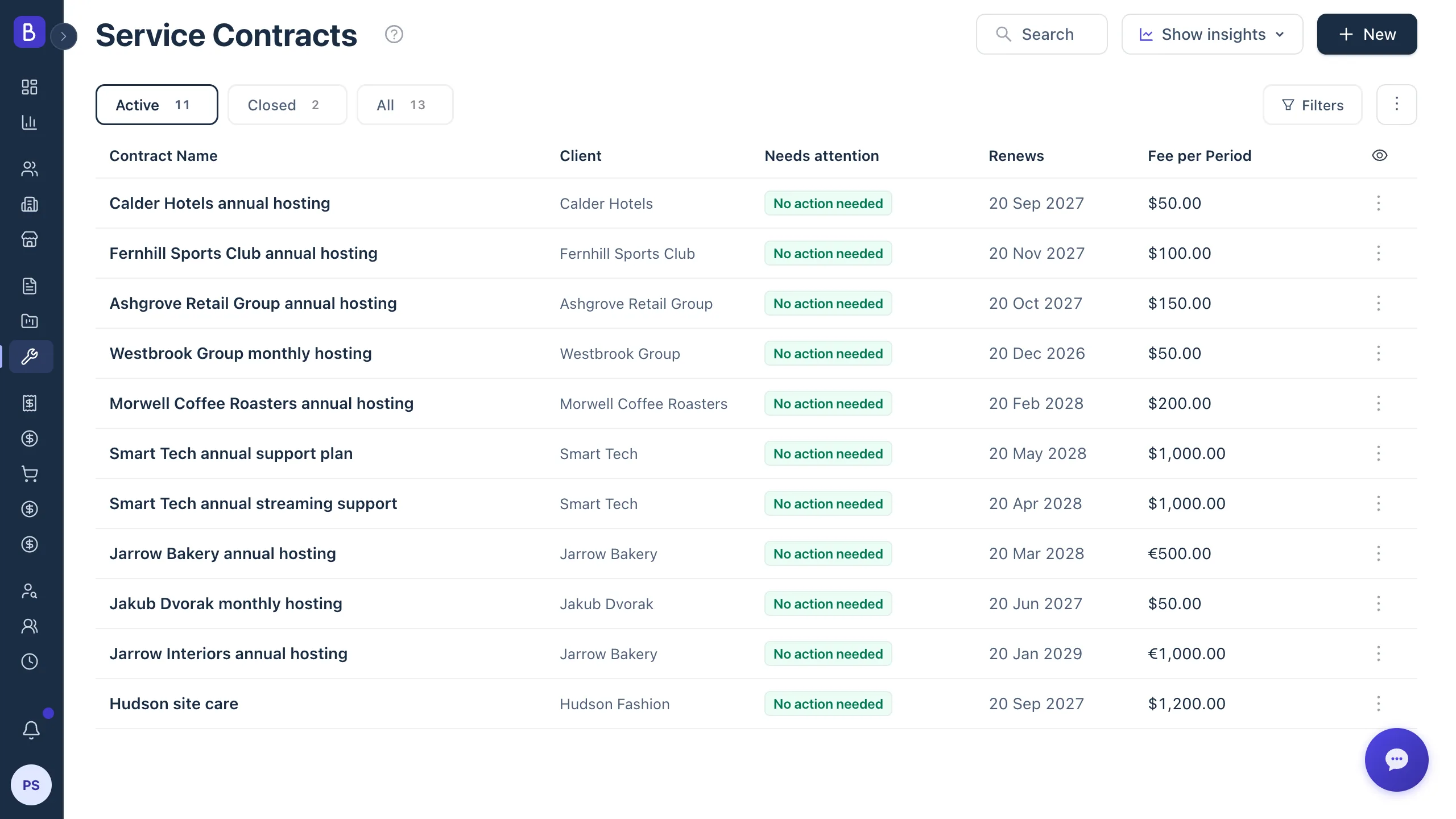
The hard part of maintenance is not selling it. It is managing it after signing. Every active contract needs a renewal signal that fires before the period ends, not a calendar reminder with no context. A practical approach is a fixed renewal window: when a contract's covered period is within about 15 days of ending, it should surface for review, and a renewal invoice should be prepared for approval. Anything past due should be flagged loudly. The point is to know which contracts need attention this week without anyone having to remember.
Maintenance contracts that surface renewals in a set window and prepare the renewal invoice remove the entire category of "we forgot that client".
Track coverage periods and payments
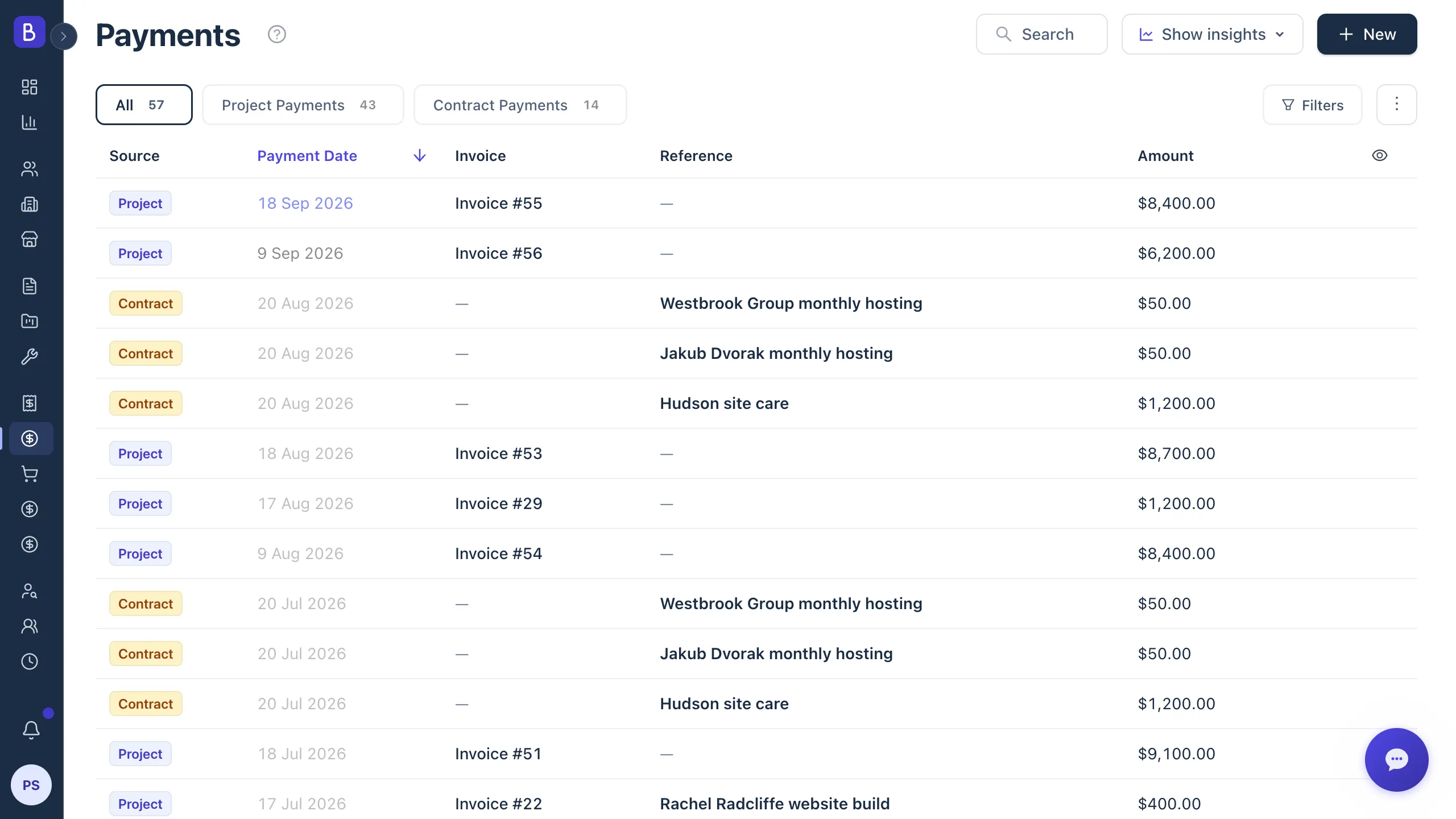
Maintenance payments are periodic, so the key question is always: which period does this payment cover, and are there any gaps? Every payment should be tied to a specific coverage window, and the amount should follow the contract terms rather than being retyped from memory each cycle. A missed period should be visible immediately, not discovered during a quarterly review. Recurring billing works best when it prepares each invoice automatically and still asks a person to approve it, which the guide on recurring invoicing best practices covers in full.
Give each contract a lifecycle stage
Give every contract a stage so its next action is never in doubt: draft, active, up for renewal, paused, and ended. An active contract with no renewal date attached is a future surprise waiting to happen, and a paused contract with no owner is a payment that quietly stopped and no one noticed. Each stage should carry an owner and a next step, so the state of the whole book is something you can see at a glance rather than reconstruct from memory when a client calls.
Warning signs a contract is lapsing
Watch for these:
- A renewal date passed and no renewal invoice went out.
- A period has no payment recorded against it.
- The client has stopped using the service but is still being billed, which is a cancellation risk.
- Hours or visits used are creeping well past what the fee assumed, which is a margin risk.
- Service levels no longer match what the client actually needs.
Each of these is a prompt for a conversation before the contract quietly ends or turns unprofitable.
Watch profitability, not just revenue
Recurring revenue is attractive, but over-service quietly erases the margin that made it attractive in the first place. Once a quarter, compare each contract's per-period fee against what it actually consumes: the hours or visits used, any emergency work, contractor cost, and how much client communication it demands. A contract that keeps running well past the effort its fee assumed needs a scope change or a price change, not another silent year at the old rate. Your own costs rise over time too, so build an annual review into the contract from the start. Clients expect a review, and it is far easier than reopening a three-year-old rate cold.
Build the first contracts from work you already do
If you do not offer maintenance yet, you are almost certainly already doing maintenance work informally: monthly check-ins, quarterly updates, small fixes, priority support that never gets billed as its own thing. Package that into two or three simple tiers, price each one for profitability rather than just coverage, and start the conversation with existing clients who already trust you. "Would you like to formalize what we already do for you?" is a far easier pitch than selling maintenance cold, and it turns loose, unbilled goodwill into predictable revenue.
Review the whole portfolio monthly
Look at all contracts together once a month. Which are healthy, which are over-serviced, which are underused, and which are due for renewal in the next 60 to 90 days? A maintenance portfolio becomes an asset when it is managed as a product line with its own review rhythm, not a folder of agreements someone opens only when a client complains.